I'm just a human who loves stuff about space. If you're here, you probably do too. I hope you like what I have to say about it.
Saturday, July 18, 2015
Claudia Alexander
On July 11, 2015, we lost one of the world's leaders and pioneers in space science, Claudia Alexander. I had seen her on the Science Channel a few times talk about planetary evolution and thus was happy to see her familiar face as part of the Rosetta team when it rendezvoused with Comet 67/P. As anyone who follows this blog knows, I actually stay up late for news on Rosetta/Philae. Claudia had a genuineness and grace about her that is a rare gift in the sciences and she will be sorely missed.
Here are a few links for those who want to get to know her a little better.
Google Scholar's listing of her work
Her Own Page (understandably not her first priority)
Her NASA profile
Her LA Times obituary
Wednesday, July 1, 2015
All Space Considered, June 2015 (David Helfand)
The bulk of the second half of All Space Considered was spent hearing from David Helfand, Chair of the Astronomy Department at Columbia University. He didn't talk much about Columbia University, instead focusing on his past seven years at Quest University in British Columbia, Canada. I'm not much for discussion on the process of education, but Dr Helfand made many very good points and shared how Quest University has attempted to address them.
His first critique of the modern University system is its adherence to traditional lecturing. In the age of the mobile Internet, the idea that some wizened elder can bestow knowledge upon a class of curious children in a way they couldn't obtain themselves is a bit archaic.
His second critique was the isolation of disciplines. It's rare for an economics professor to talk to a music professor and even rarer for either to talk to the physics departments (I guess physics is notoriously exclusive).
His third critique was that many of the skills required to succeed in the modern world are lacking. When employers are asked what they find problematic in their interviewees, it's never a lack of coding speed or inability to use a particular piece of software. What concerns them is someone's ability to communicate and ability to think about issues from many different perspectives.
To that end, Quest University has block scheduling, no departments and a very open-ended means of earning a degree. Block scheduling means that each student only has one class at any given time. That class lasts a month and they have no other educational obligations during that month. This completely eliminates scheduling conflicts and allows for studying topics in incredible depth. When the geology class goes to Hawaii to study a particular type of volcano (which is a typical sort of experience in Quest's classes), no one can say "Oh, but I have a test I need to study for."
Instead of departments, the faculty offices are all in one giant oval and are assigned by random lot. Not only does this get people thinking about creative and original collaborations, it really serves the open-ended degree mechanism well (which I'll get to next). Of course, any University could set up physical environments to encourage cross-disciplinary mixing (though most would balk at the very mention), the lack of the very concept of "department" sets all the instructors completely free. They don't have to adhere to some special set of rules for their own department that no one else even knows about.
The open-ended degree is the most interesting part to me. After the first year, students are asked to write a problem statement. They then spend the remainder of their time addressing the problem statement. That's it. Dr Helfand went into further details about the nuts and bolts of how that's done, but from a philosophical standpoint, the student chooses what to study and is simply guided by the faculty on how that might best be accomplished.
Honestly, the whole thing sounded a little too good to be true. But then again maybe that's just jealousy. I think I would definitely have enjoyed myself quite a bit in such an environment. Everyone around me seemed to think the same.
Tuesday, June 30, 2015
All Space Considered, June 2015 (Beyond the Solar System)
As usual, the fine folks at Griffith Observatory held All Space Considered on the first Friday of June 2015. Here's what they had to say about the goings-on beyond our solar system.
Galactic jets are not very well understood due to their highly relativistic nature. In layman's terms, things moving that freakin fast are hard to see clearly. What was observed for the first time in the series of pictures from Hubble taken over the span of 20 years (animated in the video below) was a collision of black hole jet material with other black hole jet material.
This in itself is a wonderful observation, but more important is that it gives us a target of observation for further study of this phenomenon. We can now watch the evolution of these jets and see how the energy is dissipated, hopefully across the entire spectrum.
Galactic Jets
For the first time, a collision of material within a black hole jet was observed. Black holes have event horizons, a proverbial point of no return. Once something crosses that event horizon, it will never escape. However, a particle with enough energy can get arbitrarily close to the event horizon and still get out. Due to the dynamics of black holes (most notably spin) those high energy particles form jets focused along the black hole's axis.Galactic jets are not very well understood due to their highly relativistic nature. In layman's terms, things moving that freakin fast are hard to see clearly. What was observed for the first time in the series of pictures from Hubble taken over the span of 20 years (animated in the video below) was a collision of black hole jet material with other black hole jet material.
This in itself is a wonderful observation, but more important is that it gives us a target of observation for further study of this phenomenon. We can now watch the evolution of these jets and see how the energy is dissipated, hopefully across the entire spectrum.
Gassy Andromeda
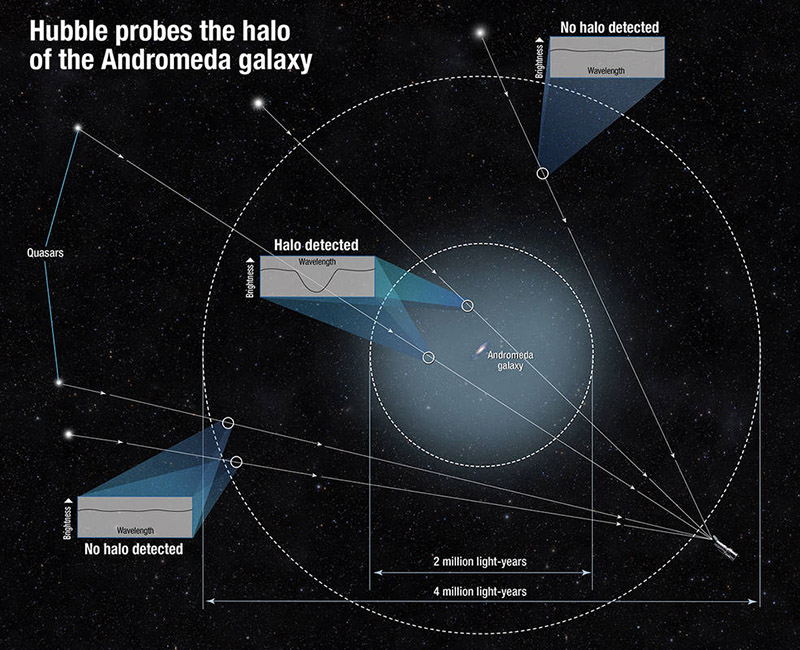
The halo of gas surrounding Andromeda, our nearest galactic neighbor, was probed much in the same way the Milky Way's jets were probed as reported in the February, 2015 edition of All Space Considered. Background quasars were used to see how far out the gassy halo extended (see image below for further explanation) and it turned out to be much larger than anticipated. In previous studies of this sort looking at halos around other galaxies, only one quasar could be used due to the distance of the galaxy and rather small portion of the sky covered as seen from Earth. Because Andromeda is so close, it appears about 6 times the diameter of the moon from Earth. This halo would cover a gargantuan 100 times the diameter of the moon in the sky. That's about half the distance from the Milky Way to Andromeda. If the Milky Way has a similar halo, it could be that the galaxies are already merging on the fringes, long before the main parts of the galaxies merge, roughly 4 billion years from now.
Dark Globular Clusters
Globular clusters with much higher mass than predicted have been found in nearby elliptical galaxy Centaurus A. This observation was made comparing the motions of over a hundred of Centaurus A's globular clusters and looking at the motions of the stars and the clusters themselves around the galaxy. When comparing the masses of the clusters from that data to the mass predicted by surveying the observable stars in the cluster, it became apparent that much of the mass is invisible. For now, it's not clear where the mass comes from. The leading candidate is dark matter. For reasons beyond my understanding, it is generally thought that globular clusters such as M13, depicted below, do not contain very much dark matter. If the clusters do indeed end up harboring dark matter, it would be a new classification of astronomical object.
Supernovae
It's starting to look like there are at least two different ways for Type 1a supernova to occur. In most popular science media I've seen, the "single-degenerate" model is shown. This is where a white dwarf sucks material off of a companion star until it hits critical mass, at which point the Type 1a supernova happens. There is also the "double-degenerate" model in which two white dwarfs merge, collectively going over the critical mass. Between two different papers published in May, evidence for both types was seen. In one paper, a supernova exhibited a spike in ultraviolet radiation, thought to be generated by the supernova slamming into the companion star. In the picture below, the brown region represents the supernova. It is shown as it engulfs the companion star, shown in white and blue.
In the other paper studying type 1a supernovae, three were examined that did not exhibit this spike. This would seem to indicate these supernovae were a result of the double-degenerate model. If the term "degenerate" confuses you, it merely refers to the number of white dwarfs involved in the supernova. White dwarfs are "degenerate" in the sense that they have stopped fusing material.
The reason cosmologists care so much about Type 1a supernova is they are a key component to the body of evidence for dark energy, that which is responsible for the accelerating expansion of the universe. The more we understand Type 1a supernovae, the more we can say about what we've seen about them at all cosmic distances, from within the Milky Way to the edge of the observable universe.
Monday, June 29, 2015
All Space Considered, June 2015 (Solar System)
As usual, the fine folks at Griffith Observatory held All Space Considered on the first Friday of June 2015. Here's what they had to say about the goings-on in our solar system. Unfortunately, due to the timing of Independence Day, there will be no July 2015 All Space Considered, but that will give you more time to prepare for Plutopalooza.
The closest approach will be quite early in the morning on July 14. However, there is no need to stay up late or get up early for the occasion for several reasons. First, it takes a few hours for radio signals sent from Pluto to reach Earth. Second, the transmissions data rate is very low (about 1kbps). Third, New Horizons has no moving parts. This means only very infrequently can it point a camera at Pluto and simultaneously point an antenna at Earth. Most of the data will be gathered and stored during the closest approach and be sent back to Earth later.
Hubble has not been ignoring Pluto just because New Horizons is on its way. It has been peering at Pluto's moons and has found that they tumble rather chaotically. Due to the high relative mass of Charon (Pluto's largest moon) to Pluto, the smaller moons are effectively navigating a binary gravitational system. This causes them to wobble in their orbits and tumble around in their rotations. This would be very disorienting because it means if you were sitting stationary on the moon's surface, you would see the sun rise from a different direction each day. Below is a video of what Nix would look like from the center of mass of the Pluto-Charon system.
NASA also has a pretty cool web app to show where New Horizons is at the moment, as well as a few others showing which of the receiving stations on Earth is collecting data from it. Due to the different directions all of our various satellites are in the solar system from Earth, several ground-based stations receive data from any given satellite.
Dwarfs
We currently have two probes studying dwarf planets. Not that long ago, "dwarf planet" wasn't even a real term. The discovery of Eris, thought by its discoverers to be the 10th planet, forced astronomers to reconsider what exactly a planet is. In doing so, it came up with three criteria.- It must orbit the sun
- It must be more or less spherical in shape due to its own gravity
- It must have cleared its orbital neighborhood
This, of course, led to the downfall of Pluto from planet status because it failed to meet criteria 3. Along with the above definition of "planet," it was decided any other body that meets criteria 1 and 2 but fails 3 would be called a "dwarf planet." This seemed an unfair fate for Pluto, beloved for decades as a planet. However, it did lift Ceres out of non-planet status. These two dwarf planets are the ones we have probes studying right now.
Pluto
The New Horizons spacecraft is the first dedicated to the study of Pluto. Back in January, Alan Stern, the Principal Scientific Investigator, visited with All Space Considered. He stated then that we would soon get our best pictures of Pluto ever and New Horizons has not disappointed. While the released images still look all blurry and pixelated, their resolution exceeds any image we've ever taken of Pluto, including by the Hubble space telescope. Also, they are getting sharper every day. Even since All Space Considered, new images have been released at even higher resolution.The closest approach will be quite early in the morning on July 14. However, there is no need to stay up late or get up early for the occasion for several reasons. First, it takes a few hours for radio signals sent from Pluto to reach Earth. Second, the transmissions data rate is very low (about 1kbps). Third, New Horizons has no moving parts. This means only very infrequently can it point a camera at Pluto and simultaneously point an antenna at Earth. Most of the data will be gathered and stored during the closest approach and be sent back to Earth later.
Hubble has not been ignoring Pluto just because New Horizons is on its way. It has been peering at Pluto's moons and has found that they tumble rather chaotically. Due to the high relative mass of Charon (Pluto's largest moon) to Pluto, the smaller moons are effectively navigating a binary gravitational system. This causes them to wobble in their orbits and tumble around in their rotations. This would be very disorienting because it means if you were sitting stationary on the moon's surface, you would see the sun rise from a different direction each day. Below is a video of what Nix would look like from the center of mass of the Pluto-Charon system.
NASA also has a pretty cool web app to show where New Horizons is at the moment, as well as a few others showing which of the receiving stations on Earth is collecting data from it. Due to the different directions all of our various satellites are in the solar system from Earth, several ground-based stations receive data from any given satellite.
Ceres
While the Dawn spacecraft continues to take many images of Ceres of breathtaking detail, the most notable features have definitely been the bright spots in one of the craters. It almost looks like a light seen through a napkin with holes in it. Such brightness amidst so many craters has not been observed thus far on any other body in the solar system. Below is one of the pictures of the bright spots.
Since All Space Considered, it has been concluded that the spots are composed of highly reflective material. What the specific material is or what process deposited them there (volcanism, erosion, etc) is still unknown.
Comet 67/P (Churyumov/Gerasimenko)
The biggest news since All Space Considered involving Comet 67/P is, of course, the awakening of Philae, the spacecraft that landed on Comet 67/P as part of ESA's Rosetta mission. Unfortunately, there has been little news from Philae. Due to its exact position on the comet being unknown and the relatively surprising nature of the initial contact, the orbiter, Rosetta, was not in an ideal position to communicate with Philae. Mission control is, of course, doing everything within reason to gather as much information from Philae as possible. The comet has become very active of late, making getting closer a somewhat dangerous affair.
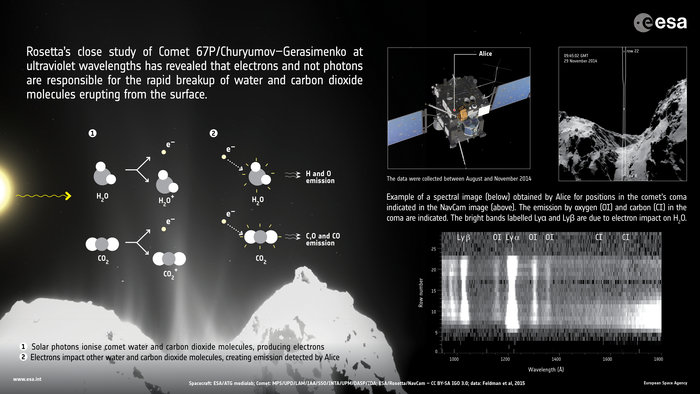
Prior to this announcement, however, there was some interesting science returned from Rosetta. It was discovered that the water and carbon dioxide plumes break down in a two-step process. From Earth, all we can deduce is that these molecules have been broken up and it had always been assumed that this was a result of ultraviolet light. Even the most powerful Earth-based and Earth-orbiting observatories can only observe the phenomenon to a resolution of miles. Rosetta is able to observe at much higher resolution and discovered that the direct breakdown of these molecules form ultraviolet light is just the first stage. Once a molecule has been broken up by ultraviolet light, energetic electrons are emitted that break up yet another molecule. They were able to deduce this by looking at the relative energies of the broken-up molecules in the ultraviolet spectrum. The following diagram illustrates this two-stage process.
Io Volcanism
We often refer to Titan, the largest moon of Saturn, as the only celestial body besides Earth to harbor standing liquid on its surface. It's possible it still is, but Io is trying to share in Titan's glory. Recent images from LBTO (a pretty badass binocular telescope) show a hot spot in a depression known as a patera. It's been well-known for some time that Io is the most volcanic body in the solar system. Naturally, some of that volcanism leads to liquid lava on its surface. What this new observation points to, however, is a lake of lava. Parts of it solidify, but other parts stay liquid and vent the heat. Below is the LBTO image (orange) overlaid on a black and white Voyager surface image at the same location.Monday, June 15, 2015
Philae Awake!
As I prepare my posts from the most recent All Space Considered, the ESA has released news that Philae is awake! I simply can not contain my joy, despite not knowing what data Philae has sent back. As yet, there are no details, but I nonetheless rejoice.
Monday, March 2, 2015
All Space Considered, Feb 2015 (The Rest)
Comet 67P (Churyumov-Gerasimenko)
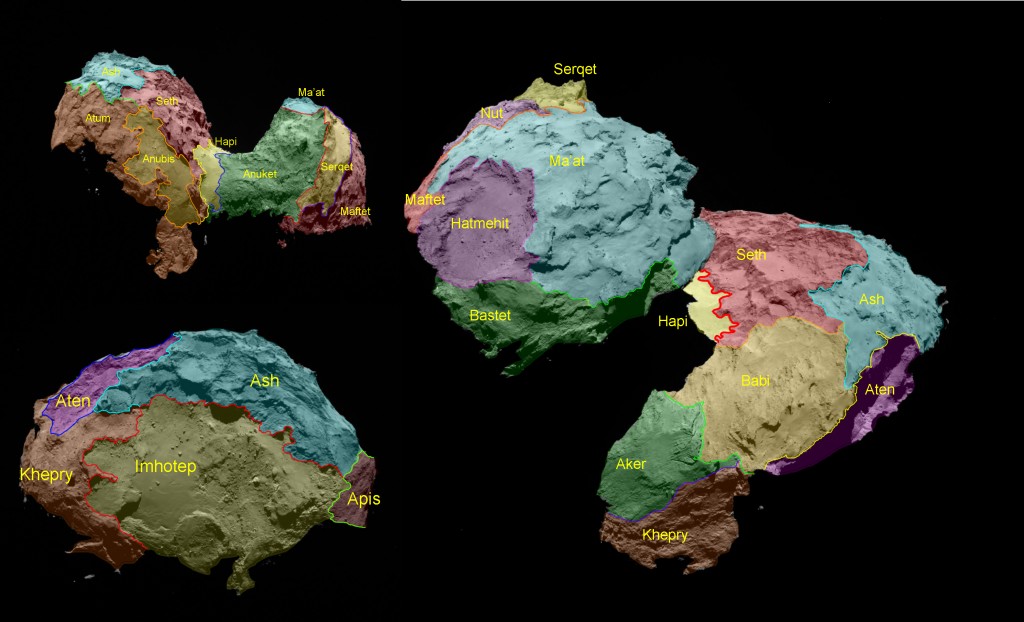
While Philae is asleep on the surface of Comet 67P, Rosetta continues to study it from a distance. A special edition of the journal Science dedicated to Rosetta's findings was published. There are far too many for me to go into detail here on all of them. The ESA's blog post on the findings gives a summary as well as resources for follow-up reading. The one item I will mention that was discussed at All Space Considered is that the surface of Comet 67P seems to have a much higher level of diversity than previously thought. Two principal ideas were put forward to account for Comet 67P's dual-lobe shape. It was hypothesized that either two bodies collided and merged or Comet 67P started as a single object and internal processes driven by close approaches to the sun blew off a middle band. Rather than just seeing one or two different surface types, as would support either of those theories, it turns out Comet 67P has 19 different regions (outlined in graphic below) that accommodate at least 5 rather diverse types of terrain. Some new theories will have to be put forth to explain Rosetta's findings.On a more human note, Comet 67P is often referred to as "Churyumov-Gerasimenko" after its two discoverers. It turns out both of them, Klim Churyumov and Svetlana Gerasimenko, had birthdays in February.
Milky Way's Puffing Black Hole
Another discovery about our Milky Way was that the black hole at the center of it is emitting plumes of material. Hubble made many observations using background quasars as a reference. By seeing how the light from these quasars change on the way through the huge outflows, chemical composition, speed and other characteristics could be deduced. It's not known exactly what caused these huge plumes to be ejected and only further observations will settle the issue. However, this is, of course, by far the closest instance of such galactic plumes, so we will be able to gather much better data on this than ones we see from other galactic centers. One idea of what might have caused this is a frenzy of star formation near the galactic center. Another idea is that a large number of stars got gobbled up by our galactic black hole around the same time, ejecting a lot more gas and other material than normal. Below is an image describing how the velocity of the material in the plumes was measured.The EAGLE Simulation
Universe simulation was again fairly successful. The EAGLE simulation started with nothing more than some energy, a huge simulated volume and the known laws of physics. It actually ended up creating galaxies, complete with spirals and ellipticals, as well as clusters and superclusters as seen in the current Universe. It's not clear to me how this differs from Illustris from back in May. There was no discussion of the differences and similarities between the two, but at least on the surface, they seem to be doing the same thing. That's a great thing in science because it provides corroboration. If one had succeeded and the other failed, the most likely cause would have been human error. In any case, here's a cool visualization of an "instant" in time during the simulation.All Space Considered, Feb 2015 (Exoplanets)
Exoplanets
Giant Ring System
So January 2015 was a good month for exoplanet news. All kinds of cool findings were made. The lead off here has a very cool video to go with it.There are lots of other pretty artist depictions of this giant ring system, but I like this video because it shows the actual transit data along the bottom. The transit method is one of the primary ways we've detected exoplanets in the past 10-20 years and usually the data tell us about the planet itself. In this case, the transit data packed quite a surprise, one whose best explanation at the moment is a huge ring system. How huge? When we think "ring system," almost universally people will think of Saturn, with good reason. It has by far the largest and most prominent ring system in our sun's domain. If the data we collected really do show a ring system as hypothesized, here's what the behemoth would look like in our sky if placed where Saturn is.
| Yup, that's our moon on the left, getting dwarfed |
Could this possibly be such a ring system that seemingly only science fiction would dream up? For me, the most convincing part is the symmetry, that the star had to pass both into and out of the ring system. I suppose the tilt of the rings and the orbit of the planet with respect to Earth's line of sight to the star might provide enough degrees of freedom to fit any data; but enough experts are convinced that I'm going to believe it for now.
Doubled the Discovered Goldilocks Planets
While the ring system makes for pretty pictures, what exoplanet hunters are really after is Earth-like planets, ones in the "Goldilocks" zone where liquid water on the surface is likely and roughly the same size as Earth. Well, we found 8 more, bringing the overall total to 16. Such planets are of extreme interest for at least two reasons. The first is that human-like life is most likely to exist on such a planet. There is always the possibility that non-human-like life exists on other planets, but we're of course most interested in the life that we are most compatible with. The second reason is exploring the possibility of human life somewhere besides Earth. Mars occasionally comes up as a candidate, but its thin atmosphere makes it a pretty poor candidate. It is still nonetheless the best candidate in the solar system. That means to find a truly great candidate, we must look beyond our solar system.Super-Earths Superer than Earth at Holding Oceans
Another point of discussion was theoretical work done regarding the development of oceans and a planet's ability to retain one oceans once they had been established. It is, of course, nice if a planet has liquid water. However, if it is like Mars, that water disappears quickly and the window of opportunity for life as we know it to form is over. Harvards Center for Astrophysics has determined that planets 2-4 times the mass of Earth seem to be the best at both forming oceans and retaining them once formed. The main impact of this research is that if we want to look for liquid water, we should target searches for planets in this mass range most heavily.It bears remarking that the rate of exoplanet discovery in the past 10 years has been just plain crazy. Not long ago, we weren't even sure if we could detect exoplanets. Now, we've found more than all but the most popular people have friends on Facebook. It's almost certain that we'll find more than the single most popular person has friends on Facebook soon. "Friends on Facebook" may seem a frivolous measure, but I bring it up because it means that for each person you have had any personal interaction with, there is an exoplanet that has been discovered and confirmed. Given that all of this has happened within a relatively small region of our own galaxy, which itself is only one of hundreds of billions in the observable Universe, and the sheer scale of the diversity and possibilities become incomprehensible rather quickly.
NGTS
In the vein of accelerated discovery, a new planet-hunting telescope saw first light in January. I'm not sure if this was indeed mentioned at All Space Considered, but I think it's important enough to mention. To date, the space-based Kepler telescope has been doing the lion's share of the exoplanet discovery. It has been hobbled of late by failing mechanics, but had long surpassed its original mission length and still continues to amazing work even in its current state. NGTS is a ground-based telescope that will look at much brighter stars than Kepler and sweep out a larger region of the sky than Kepler. Like Kepler, much of NGTS's work will be to provide candidates for follow-on observations with more specialized telescopes. Standard transit observations can deduce size, mass and orbit of an exoplanet. Follow-on measurements use spectroscopy while the planet is in-transit to determine the chemical composition and depth of the planet's atmosphere.
Subscribe to:
Posts (Atom)