Dwarfs
We currently have two probes studying dwarf planets. Not that long ago, "dwarf planet" wasn't even a real term. The discovery of Eris, thought by its discoverers to be the 10th planet, forced astronomers to reconsider what exactly a planet is. In doing so, it came up with three criteria.- It must orbit the sun
- It must be more or less spherical in shape due to its own gravity
- It must have cleared its orbital neighborhood
This, of course, led to the downfall of Pluto from planet status because it failed to meet criteria 3. Along with the above definition of "planet," it was decided any other body that meets criteria 1 and 2 but fails 3 would be called a "dwarf planet." This seemed an unfair fate for Pluto, beloved for decades as a planet. However, it did lift Ceres out of non-planet status. These two dwarf planets are the ones we have probes studying right now.
Pluto
The New Horizons spacecraft is the first dedicated to the study of Pluto. Back in January, Alan Stern, the Principal Scientific Investigator, visited with All Space Considered. He stated then that we would soon get our best pictures of Pluto ever and New Horizons has not disappointed. While the released images still look all blurry and pixelated, their resolution exceeds any image we've ever taken of Pluto, including by the Hubble space telescope. Also, they are getting sharper every day. Even since All Space Considered, new images have been released at even higher resolution.
The closest approach will be quite early in the morning on July 14. However, there is no need to stay up late or get up early for the occasion for several reasons. First, it takes a few hours for radio signals sent from Pluto to reach Earth. Second, the transmissions data rate is very low (about 1kbps). Third, New Horizons has no moving parts. This means only very infrequently can it point a camera at Pluto and simultaneously point an antenna at Earth. Most of the data will be gathered and stored during the closest approach and be sent back to Earth later.
Hubble has not been ignoring Pluto just because New Horizons is on its way. It has been peering at Pluto's moons and has found that they tumble rather chaotically. Due to the high relative mass of Charon (Pluto's largest moon) to Pluto, the smaller moons are effectively navigating a binary gravitational system. This causes them to wobble in their orbits and tumble around in their rotations. This would be very disorienting because it means if you were sitting stationary on the moon's surface, you would see the sun rise from a different direction each day. Below is a video of what Nix would look like from the center of mass of the Pluto-Charon system.
NASA also has a pretty cool web app to show where New Horizons is at the moment, as well as a few others showing which of the receiving stations on Earth is collecting data from it. Due to the different directions all of our various satellites are in the solar system from Earth, several ground-based stations receive data from any given satellite.
Ceres
While the Dawn spacecraft continues to take many images of Ceres of breathtaking detail, the most notable features have definitely been the bright spots in one of the craters. It almost looks like a light seen through a napkin with holes in it. Such brightness amidst so many craters has not been observed thus far on any other body in the solar system. Below is one of the pictures of the bright spots.

Since All Space Considered, it has been concluded that the spots are composed of highly reflective material. What the specific material is or what process deposited them there (volcanism, erosion, etc) is still unknown.


Since All Space Considered, it has been concluded that the spots are composed of highly reflective material. What the specific material is or what process deposited them there (volcanism, erosion, etc) is still unknown.
Comet 67/P (Churyumov/Gerasimenko)
The biggest news since All Space Considered involving Comet 67/P is, of course, the awakening of Philae, the spacecraft that landed on Comet 67/P as part of ESA's Rosetta mission. Unfortunately, there has been little news from Philae. Due to its exact position on the comet being unknown and the relatively surprising nature of the initial contact, the orbiter, Rosetta, was not in an ideal position to communicate with Philae. Mission control is, of course, doing everything within reason to gather as much information from Philae as possible. The comet has become very active of late, making getting closer a somewhat dangerous affair.
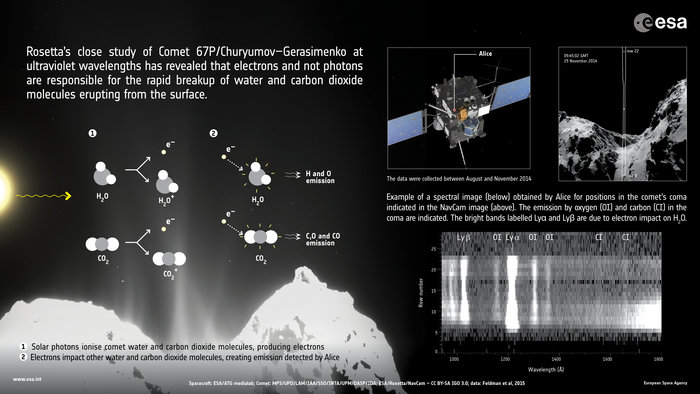
Prior to this announcement, however, there was some interesting science returned from Rosetta. It was discovered that the water and carbon dioxide plumes break down in a two-step process. From Earth, all we can deduce is that these molecules have been broken up and it had always been assumed that this was a result of ultraviolet light. Even the most powerful Earth-based and Earth-orbiting observatories can only observe the phenomenon to a resolution of miles. Rosetta is able to observe at much higher resolution and discovered that the direct breakdown of these molecules form ultraviolet light is just the first stage. Once a molecule has been broken up by ultraviolet light, energetic electrons are emitted that break up yet another molecule. They were able to deduce this by looking at the relative energies of the broken-up molecules in the ultraviolet spectrum. The following diagram illustrates this two-stage process.
Io Volcanism
We often refer to Titan, the largest moon of Saturn, as the only celestial body besides Earth to harbor standing liquid on its surface. It's possible it still is, but Io is trying to share in Titan's glory. Recent images from LBTO (a pretty badass binocular telescope) show a hot spot in a depression known as a patera. It's been well-known for some time that Io is the most volcanic body in the solar system. Naturally, some of that volcanism leads to liquid lava on its surface. What this new observation points to, however, is a lake of lava. Parts of it solidify, but other parts stay liquid and vent the heat. Below is the LBTO image (orange) overlaid on a black and white Voyager surface image at the same location.

No comments:
Post a Comment