Comet 67P (Churyumov-Gerasimenko)
While Philae is asleep on the surface of Comet 67P, Rosetta continues to study it from a distance. A special edition of the journal Science dedicated to Rosetta's findings was published. There are far too many for me to go into detail here on all of them. The ESA's blog post on the findings gives a summary as well as resources for follow-up reading. The one item I will mention that was discussed at All Space Considered is that the surface of Comet 67P seems to have a much higher level of diversity than previously thought. Two principal ideas were put forward to account for Comet 67P's dual-lobe shape. It was hypothesized that either two bodies collided and merged or Comet 67P started as a single object and internal processes driven by close approaches to the sun blew off a middle band. Rather than just seeing one or two different surface types, as would support either of those theories, it turns out Comet 67P has 19 different regions (outlined in graphic below) that accommodate at least 5 rather diverse types of terrain. Some new theories will have to be put forth to explain Rosetta's findings.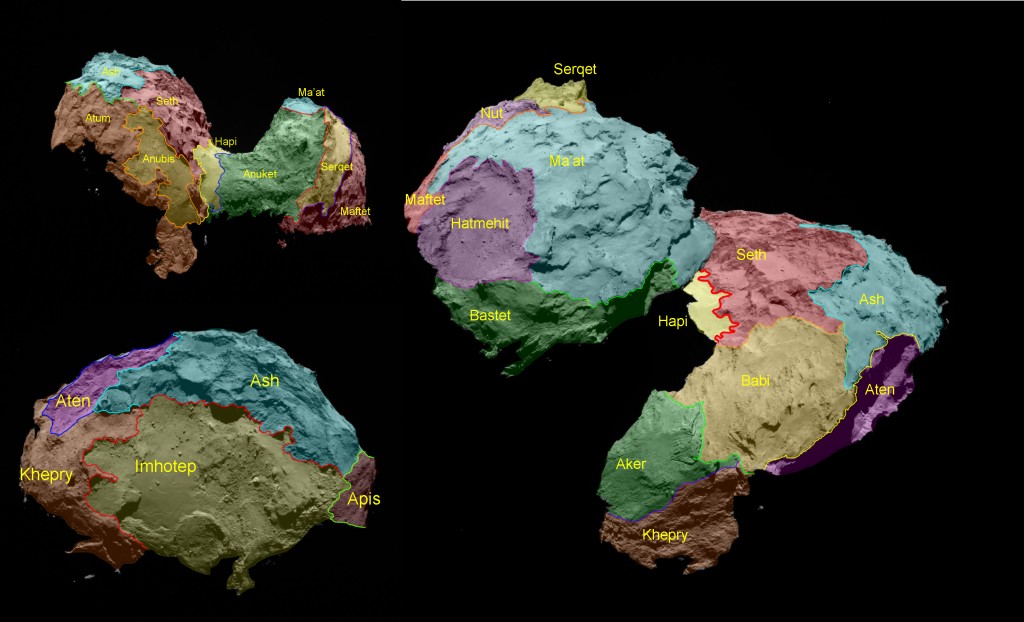
On a more human note, Comet 67P is often referred to as "Churyumov-Gerasimenko" after its two discoverers. It turns out both of them, Klim Churyumov and Svetlana Gerasimenko, had birthdays in February.
Milky Way's Puffing Black Hole
Another discovery about our Milky Way was that the black hole at the center of it is emitting plumes of material. Hubble made many observations using background quasars as a reference. By seeing how the light from these quasars change on the way through the huge outflows, chemical composition, speed and other characteristics could be deduced. It's not known exactly what caused these huge plumes to be ejected and only further observations will settle the issue. However, this is, of course, by far the closest instance of such galactic plumes, so we will be able to gather much better data on this than ones we see from other galactic centers. One idea of what might have caused this is a frenzy of star formation near the galactic center. Another idea is that a large number of stars got gobbled up by our galactic black hole around the same time, ejecting a lot more gas and other material than normal. Below is an image describing how the velocity of the material in the plumes was measured.
The EAGLE Simulation
Universe simulation was again fairly successful. The EAGLE simulation started with nothing more than some energy, a huge simulated volume and the known laws of physics. It actually ended up creating galaxies, complete with spirals and ellipticals, as well as clusters and superclusters as seen in the current Universe. It's not clear to me how this differs from Illustris from back in May. There was no discussion of the differences and similarities between the two, but at least on the surface, they seem to be doing the same thing. That's a great thing in science because it provides corroboration. If one had succeeded and the other failed, the most likely cause would have been human error. In any case, here's a cool visualization of an "instant" in time during the simulation.

I received an email asking what the significance of the plumes are. Cosmologists don't like to leave anything unexplained. These plumes are an important historical marker. Something happened 2 million years ago and knowing what it was and how it came to be will help us understand galactic formation and evolutionary dynamics. We can use this information about the Milky Way to figure out what is going on in other galaxies where we see this phenomenon.
ReplyDeleteAs a non-physicist, non-astronomer, my personal hope is that the Milky Way's black hole used to be a quasar and this is the sputtering exhaust leftover from running out of fuel to sustain quasaric activity. I'm probably wrong, but I like the idea of looking up at the sky and seeing a bright line of black hole ejecta.