Compiling all the images into a video was the most challenging part of the process. As I've noted in previous posts, pointing of the camera was both manual and done without an equatorial mount, meaning both Jupiter's position within the picture and the Galilean Moons' orientation around Jupiter changed from frame to frame.
Luckily, I write software for a living and had more than a little training in image processing as a college dork. Putting the two together, I got the images mostly aligned. There are some very glaring exceptions. Almost all of these are due to insisting on taking pictures under non-ideal conditions. Jupiter and the Galilean Moons are still visible through thin clouds, but either a huge halo emerges around Jupiter (too much light) or the Moons become very dim (not enough light). Both of these conditions tripped up my automated aligning, forcing me to hand-adjust quite a few frames. I won't go into too much detail here about the software itself, though I'll post it on Github eventually.
One tip to anyone trying to do the same is don't use generalized computer vision libraries. Most of them do terribly with backyard astrophotos. They assume a lot of light and a lot of color and a lot of features. Until images can fill the frame with the object in question, all of these assumptions are bad for astrophotos. I converted my images to black/white first (literally black/white, no gray; 1-bit for you computer nerds) to obtain better results than trying to use the generalized computer vision libraries.
I used MATLAB for the image alignment and video rendering. For the soundtrack, I used some clips I captured on my phone, processed and added to the video in Final Cut Pro. I considered doing some titling and text overlays, but decided sharing the video was more valuable than perfecting the presentation. Both MATLAB and Final Cut Pro are pricey options in terms of software. Octave, Julia and Mathematica are all options to MATLAB, though I've used none and can't attest to the pros/cons of each. For the rudimentary work I used Final Cut Pro for, iMovie would likely have done just as well.
That's pretty much it. If anyone has questions or comments, feel free to ask or post in the comments section.
Tuesday, June 20, 2017

Monday, June 19, 2017
Full Io Orbit How-To, Part 2 -- Photography
Actually taking the photos was, of course, the most rewarding part of this whole process. In addition to looking around at the rest of the night sky and appreciating just how light-polluted Los Angeles is, I got to see the Galilean Moons actually dance their orbital dance, both minute-by-minute and night-by-night. Capturing what I saw on camera was the least I could do to illuminate this celestial beauty. Here are some of the nuts and bolts details of how I did it.
For reasons I'm still not terribly clear on, aperture is specified not by the diameter of the aperture, but by an "f-stop" or "f-number." The f-stop is the fraction of a focal length that the diameter of the aperture is. So, in my setup (300mm focal length), an f-stop of f/8 means the aperture is 37.5mm (= 300mm / 8). In addition to allowing more light, lower f-stops reduce the range of distance from the camera in which things are in focus (known as a "depth of field"). Any given lens will usually be specified by its minimum f-stop, which is the largest the aperture can be. So a 300mm, f/5.6 lens can open its aperture up to 53.6 mm (= 300mm / 5.6).
Finding good times to observe portions of the orbit that haven't already been photographed was crucial. There are some nice sites devoted to showing the Galilean Moons' placement in the sky (I used this one a lot). I found their principal usefulness to be qualitative. When I really needed to drill down to when the next 3-minute window was, I cooked up my own simple Python script. I will eventually post it to github and update with a link here.
How Often to Shoot
I decided rather arbitrarily to take a picture every three minutes. This worked out well for a few reasons. First, that amounted to about 850 frames. At 24 fps, the video would be about 35s long, a nice length. Further, getting at least one picture every half-degree of Io's orbit seemed like another nice metric to hit. In hindsight, it was overkill, as Io's orbit only traverses about 120-150 pixels of the image with my camera's setup. However, what's nice about overkill is things aren't ruined by having one bad frame. Dropping a single frame when taking them every half-degree is pretty innocuous. Most importantly for me, however, 3 minutes was about how quickly I could take a picture, open it up on my laptop, zoom in, review and take another picture if I didn't like what I saw. Now that I've done it 850 times, I could probably get this down to 1 minute (though doing so would be stressful).Camera Settings
Most cameras come with various automatic settings, things like portrait, landscape, action, etc. At least with my camera (though I suspect this to be true of most cameras), none of these was useful for this endeavor. The amount of light assumed by all of these presets far exceeds what was in my typical frame. I decided to go full manual, which most DSLR's will allow. There are really only three settings that matter: exposure time, aperture and sensitivity (aka "ISO"). I'll go through each of these separately.Exposure Time
The longer the exposure, the more light enters the camera and the brighter the image. Without a tracking mount, there is a maximum exposure time before the rotation of the Earth leads to blurring in the image. At 300mm focal length, I found this maximum time to be about 1/3 second. Luckily, Jupiter itself is quite bright, so very short exposures can still capture it. However, to get the Galilean Moons, longer exposures are required. They're bright, but not that bright.
Aperture
Aperture is the size of the hole that light is allowed in through the camera to the imager. For the purposes of focusing at infinity, the only thing aperture affects is how much light gets in. The larger the aperture (low f-stop), the more light hits the imager. F-stop affects other things in terrestrial photography, most notably the depth of field. If you don't care about this, you can skip the next paragraph.For reasons I'm still not terribly clear on, aperture is specified not by the diameter of the aperture, but by an "f-stop" or "f-number." The f-stop is the fraction of a focal length that the diameter of the aperture is. So, in my setup (300mm focal length), an f-stop of f/8 means the aperture is 37.5mm (= 300mm / 8). In addition to allowing more light, lower f-stops reduce the range of distance from the camera in which things are in focus (known as a "depth of field"). Any given lens will usually be specified by its minimum f-stop, which is the largest the aperture can be. So a 300mm, f/5.6 lens can open its aperture up to 53.6 mm (= 300mm / 5.6).
Sensitivity
Back when cameras still used film, the ISO number referred to how quickly the chemicals on the film would react to light. Lower ISO numbers meant a slower reacting film. This setting on a digital camera is intended to mimic old photochemical film. For astrophotography, getting brighter pictures is almost always good, so using a high ISO is usually preferred. However, it should be noted that a high ISO also leads to higher noise in the photograph, as things that appear black to the eye don't to the camera.
Final Settings
After some experimentation, I settled on 1/4s exposures at f/6.3 and 6400 ISO. These were the settings I used on very clear nights. A discerning eye will notice a lot of pictures taken on not-so-clear nights. For those, I would adjust the exposure or sensitivity.
Time
While putting together a video of Io's full orbit was quite both challenging and fun, more than either of these, it was a commitment of time. Io's orbit is 42.5 hours. There's simply no way around spending that amount of time taking pictures. Further, overlap with portions of the orbit that have already been photographed keep increasing. At first, just going out when convenient to take some pictures was unlikely to find Io in the same place in its orbit around Jupiter as it was in photographs already taken. Towards the end, it was just the opposite and it became harder and harder to find good times for observing. Missing an opportunity means waiting 42.5 hours for it to come around again. Even the willingness to just drop everything when that time comes may be thwarted by the rising and setting of the Sun or Jupiter. This is all to say nothing of a ground-based astrophotographer's absolute worst enemy, clouds.Finding good times to observe portions of the orbit that haven't already been photographed was crucial. There are some nice sites devoted to showing the Galilean Moons' placement in the sky (I used this one a lot). I found their principal usefulness to be qualitative. When I really needed to drill down to when the next 3-minute window was, I cooked up my own simple Python script. I will eventually post it to github and update with a link here.
Saturday, June 17, 2017
Full Io Orbit How-To, Part 1 -- Gear
Like a good scientist, I want others to be able to reproduce my results. In this series of three posts, I'll outline each step I took along the way. There's plenty of information out there on other ways to do this, but this is what I did.
Lens wipes are a must. Depending on where you live, either humidity or dust may collect on the camera lens. It's always good to have some wipes around to clear anything off, especially in astrophotography, where the camera is pointed primarily up most of the time.
Jacket, hat and gloves. Even in sunny Southern California, nights can get cold. Staying warm for half an hour or so isn't so bad without warm clothing. Staying out 2-4 hours, even in what seems like a balmy 60F at first, can get chilly. And even if your polar bear self can hack it, it's best to have these items along and not need them than the opposite.
An equatorial tracking mount would have made my life way easier. Pointing each frame individually by hand meant that the placement of Jupiter in the frame as well as the orientation of the Galilean Moons relative to Jupiter changed slightly with each frame. An equatorial tracking mount would have at least kept each night's set of photos placed and oriented identically. As I'll note in my post-production post, framing and orienting all 800+ frames was a real chore. With an equatorial tracking mount, I would only have had to frame and orient 20 to 25 frames.
No matter how nice a set up you have, you can always wish for better optics, either higher magnification or a larger aperture. Though I used just a camera and lens for the Galilean Moons video, it will be more economical to get a telescope for further planetary astrophotography. Saturn's ring gap, for instance, can not be resolved with the setup I used for this video. The expense of just jumping to a 400mm lens (as noted above, $1150) can buy a pretty nice telescope and mount. Also, a telescope with a given focal length can achieve a wide range of magnification by using different eyepieces, which are far more economical than ratcheting up camera lens focal length.
Gear
Camera
The first thing needed to take pictures of the Galilean Moons is, of course, a camera. For this video, I used a Canon Rebel T5i, though any DSLR should do just fine. Canon and Nikon aren't the only options, they seem to be the most popular and, as a result, are likely the most economical for a given level of performance. I hear CCD cameras are good too, but don't know much about them.Lens
The next thing to consider is the camera lens. I used a Canon 75-300mm, f/4-5.6 zoom lens set to 300mm. For the purposes of astrophotography, a camera lens's focal length correlates to magnification (large focal length means large magnification). Going past 300mm starts to get very expensive. My lens was only $250. The cheapest lens Canon sells with a focal length longer than 300mm goes for $1150. There are also teleconverters available that extend the focal length at the expense of f-number (ie, relative aperture). These achieve a longer focal length for a lower price, but may sacrifice auto-focus capability (not generally needed for astrophotography, but can be useful).Tripod
A tripod is a really nice accessory for astrophotography. The Galilean Moons are bright enough that relatively short exposures compared to constellations or nebula will work; but the necessary exposure time may be long enough that holding the camera by hand isn't steady enough to get nice, sharp pictures at high magnification. This was certainly the case for me, so I used a tripod for all of my pictures. The guy at the camera store sold me on a Mefoto Globetrotter.Miscellaneous
Though not necessary, having a laptop is really nice. At the magnification being used, touching the camera introduces a lot of wobble and blurs the pictures. Though a simple, cheap remote would do the job, I really liked being able to review the pictures I took on a big screen as I was taking them. Also, it saves me the (minor) hassle of transferring images from the flash drive in the camera to a computer later. Canon's DSLRs can be controlled through EOS Utility 2.Lens wipes are a must. Depending on where you live, either humidity or dust may collect on the camera lens. It's always good to have some wipes around to clear anything off, especially in astrophotography, where the camera is pointed primarily up most of the time.
Jacket, hat and gloves. Even in sunny Southern California, nights can get cold. Staying warm for half an hour or so isn't so bad without warm clothing. Staying out 2-4 hours, even in what seems like a balmy 60F at first, can get chilly. And even if your polar bear self can hack it, it's best to have these items along and not need them than the opposite.
Gear I Wish I Had
Over the course of spending 42.5 hours with my gear, there were definitely items I wish I had.An equatorial tracking mount would have made my life way easier. Pointing each frame individually by hand meant that the placement of Jupiter in the frame as well as the orientation of the Galilean Moons relative to Jupiter changed slightly with each frame. An equatorial tracking mount would have at least kept each night's set of photos placed and oriented identically. As I'll note in my post-production post, framing and orienting all 800+ frames was a real chore. With an equatorial tracking mount, I would only have had to frame and orient 20 to 25 frames.
No matter how nice a set up you have, you can always wish for better optics, either higher magnification or a larger aperture. Though I used just a camera and lens for the Galilean Moons video, it will be more economical to get a telescope for further planetary astrophotography. Saturn's ring gap, for instance, can not be resolved with the setup I used for this video. The expense of just jumping to a 400mm lens (as noted above, $1150) can buy a pretty nice telescope and mount. Also, a telescope with a given focal length can achieve a wide range of magnification by using different eyepieces, which are far more economical than ratcheting up camera lens focal length.
Friday, June 16, 2017
Full Io Orbit
In case anyone missed it, Jupiter is super cool. Not only is Jupiter the King of the Planets, but it is so bright, it hides 4 moons that would otherwise be visible to the unaided eye; and each of these hidden moons is interesting in its own right. Io is the most volcanically active object in the Solar System. Europa is a prime candidate for the search for life beyond Earth. Ganymede is the largest moon. And Callisto has the oldest surface in the Solar System.
Collectively, these 4 moons are known as the Galilean Moons, named after Galileo, who discovered them in 1610. The telescope had only just been invented, so it's not surprising that with really quite modest equipment by modern standards, the Galilean Moons can be resolved and imaged.
With that as context, I present the below video. This was stitched together from several hundred photos taken over many nights at 3 minute intervals. Taken together, all of the frames show a full orbit of Io around Jupiter.
For now, enjoy the video. A how-to and further thoughts will be forthcoming. Note that Io starts in front of Jupiter and emerges about 4s in.
Collectively, these 4 moons are known as the Galilean Moons, named after Galileo, who discovered them in 1610. The telescope had only just been invented, so it's not surprising that with really quite modest equipment by modern standards, the Galilean Moons can be resolved and imaged.
With that as context, I present the below video. This was stitched together from several hundred photos taken over many nights at 3 minute intervals. Taken together, all of the frames show a full orbit of Io around Jupiter.
For now, enjoy the video. A how-to and further thoughts will be forthcoming. Note that Io starts in front of Jupiter and emerges about 4s in.
Tuesday, June 13, 2017
Saturn
Another picture taken with the 400mm, f/5.6 lens attached to a 2x extender.

What can I say about Saturn that Saturn doesn't say for itself? In this picture, you can see the rings really are rings, though you'd be forgiven if you thought there was only one. Imaging the gap between the Saturn and its rings is especially cool when the rings are inclined this much from Earth's perspective.

What can I say about Saturn that Saturn doesn't say for itself? In this picture, you can see the rings really are rings, though you'd be forgiven if you thought there was only one. Imaging the gap between the Saturn and its rings is especially cool when the rings are inclined this much from Earth's perspective.
Thursday, June 8, 2017
Crescent Venus
I rented a 400mm lens with a 2x extender to see what it could do. This is what Venus looked like.

I was a bit surprised that the image wasn't sharper. That may have been my fault. With the 2x extender, I was forced to manually focus and Venus was small enough to be difficult to tell whether the focus was right.
Nonetheless, the crescent shape of Venus is clear. This was one of the primary pieces of evidence that led to the downfall of an Earth-centered Universe. Mercury has phases too, but it's really difficult to image, making Venus one providing the convincing evidence.
I was a bit surprised that the image wasn't sharper. That may have been my fault. With the 2x extender, I was forced to manually focus and Venus was small enough to be difficult to tell whether the focus was right.
Nonetheless, the crescent shape of Venus is clear. This was one of the primary pieces of evidence that led to the downfall of an Earth-centered Universe. Mercury has phases too, but it's really difficult to image, making Venus one providing the convincing evidence.
Monday, May 22, 2017
Jupiter and the Galilean Moons
I happen to be out in my backyard this weekend during that sliver of time when the sky is dark enough to see Jupiter with the unaided eye, but not so dark that the sky is black yet. Unlike the moon, which is usually visible during most daylight hours, the planets are difficult to spot against a blue sky except at dawn and dusk. I managed to snap the following picture that also shows the Galilean moons.

I did cheat just a little. I took a long exposure, which made the sky bluer in the picture than it looked to the unaided eye. The long exposure is revealed if you click on the picture to enlarge it. You'll see the motion blur from the Earth's rotation. I don't have a tracking mount, so I still get "star trails" when I take long exposures at high magnification.

I did cheat just a little. I took a long exposure, which made the sky bluer in the picture than it looked to the unaided eye. The long exposure is revealed if you click on the picture to enlarge it. You'll see the motion blur from the Earth's rotation. I don't have a tracking mount, so I still get "star trails" when I take long exposures at high magnification.
Friday, April 21, 2017
Backyard Astrophotography -- The Big Dipper
Been pointing my camera skyward at night of late. There's a lot to it, but I'm sort of starting to get the hang of it. Here is a series of 3 pictures of the Big Dipper with everything on the camera set the same except exposure time. I like that you can go from a bunch of dots to what are more or less just the principal stars in the constellation (something you'll see much more clearly if you click on the images to get larger versions).
I should note that these are raw images. Far clearer images can be obtained with stacking. From what I understand, that's particularly useful when there is lots of detail in the subject (nebulae, close-ups of planets, etc).
 |
| A 30s exposure |
 |
| A 20s exposure |
 |
| A 10s exposure |
I should note that these are raw images. Far clearer images can be obtained with stacking. From what I understand, that's particularly useful when there is lots of detail in the subject (nebulae, close-ups of planets, etc).
Friday, January 1, 2016
All Space Considered, December 2015 (The Greater Cosmos)
Milky Way's Black Hole's Magnetic Fields Measured
Black holes are usually talked about in terms of their gravity. This is perfectly natural, of course, given both the fundamental nature of black holes and how we humans happened upon them (theoretical anomaly in General Relativity). However, there's no reason to ignore their magnetic fields. Luckily, they aren't being ignored. The Event Horizon Telescope (EHT) took measurements of our own galaxy's central black hole. For the first time, the resolution of our measurements was able to look almost right down to the event horizon of the Milky Way's central black hole. This will provide valuable information regarding how jets form around black holes.

Given all there is surrounding a galaxy's central black hole, optical imaging is impossible. Instead, the EHT looked at "light" with a 1.3mm wavelength. While the black hole is particularly bright there, the important feature of the light was the polarization. That gives the most information regarding the local magnetic fields. It should also be noted that EHT is making use of very long baseline interferometry (VLBI) to mimic a much larger telescope. This technique improved resolution to the degree needed to make such detailed observations. Though black holes are hugely massive, their density makes them smaller than one might think. This particular study was doing the equivalent of looking at a golf ball on the moon.

Given all there is surrounding a galaxy's central black hole, optical imaging is impossible. Instead, the EHT looked at "light" with a 1.3mm wavelength. While the black hole is particularly bright there, the important feature of the light was the polarization. That gives the most information regarding the local magnetic fields. It should also be noted that EHT is making use of very long baseline interferometry (VLBI) to mimic a much larger telescope. This technique improved resolution to the degree needed to make such detailed observations. Though black holes are hugely massive, their density makes them smaller than one might think. This particular study was doing the equivalent of looking at a golf ball on the moon.
Planetary Nebulae
A new way to determine the distance to planetary nebula was announced. The name "planetary nebula" is a misnomer in that they have nothing to do with planets. However, the name has stuck for historical reasons. Planetary nebula are actually the remnants of now-dead stars. Studying them gives great insight into the stellar life cycle. One thing that has plagued people studying them, however, is that the distances to them is difficult to measure. Unlike stars, planetary nebula are diffuse in the sky and, as can be seen in the picture below, their diversity makes it hard to pick any given feature to home-in on as an age signifier.

However, scientists have indeed found a characteristic that will allow them to gauge the distance to planetary nebula. Though not new, it used much more up-to-date and accurate corroborating data. In addition to publishing the method, which combines reddening and hydrogen emission lines, a catalog of over 1000 distances using this new method was created.
Highest Mass-to-light Ratio Galaxy Found
A galaxy with a record mass-to-light ratio was discovered. Well, we've known about Triangulum II for some time, but we just discovered that its mass-to-light was a whopping 3500 or so (for reference, the Universe's mass-to-light is about 100). Mass-to-light is used as a measure of dark matter. If a lot of mass can be inferred at a location, but we see very few stars, we now assume the difference is predominantly dark matter. If this result stands, it would be an incredible opportunity to study dark matter, as Triangulum II is quite close on a cosmic scale, just barely beyond the furthest edges of our own galaxy, the Milky Way.

Personally, I'm a touch skeptical of this result. The study is basing its results on the velocities of six stars. Others have already put forth the alternative hypothesis that the Milky Way is pulling and tugging on those stars to alter their motion. Nonetheless, I do hope the result is correct and look forward to the follow-on work.
Cheshire Cat Fossil Galaxy
Well, some good science is coming out of this one, but mostly, it's a pretty picture.

This is the Cheshire Cat group of galaxies. It was posted by NASA the week of the 100th anniversary of Einstein's publication of his General Theory of Relativity. That theory predicted gravitational lensing and this picture is a particularly amusing example of that prediction realized. You can read the NASA post for full details about the what's where in this image. The main features are the eyes, which are two galaxies on a collision course with each other, and four background galaxies that are gravitationally lensed into arcs forming the facial outlines and smile of the cat.
Wednesday, December 16, 2015
All Space Considered, December 2015 (Exoplanets and Stars)
Exoplanet Formation Imaged
In the past decade or two, we've been finding exoplanets like crazy. Despite what you may have heard about Kepler's discoveries, there are almost 2,000 confirmed exoplanets with absolutely no slowdown in the discovery rate in sight. Though Kepler has been hobbled somewhat, the mission scientists and engineers have kept it fairly productive through very innovative and ingenious methods. Additionally, NASA has a swanky new exoplanet-hunting satellite scheduled for launch next year, TESS.
The big news this month is that we actually imaged a planet forming. This is the photo released to the press.

This is the LkCa 15 system. You can see the star's protoplanetary disk on the left. On the right, you see the planets up close. While it may not look like much, what's important here is that a particular emission line from planet b shows that lots of material is falling onto it. That process causes a lot of heat, creating ions that wouldn't be there otherwise. Those ions are generating the emission line that is strong enough to indicate actual accretion occurring in this very picture.
Most Earth-like Exoplanet Not Very Habitable
Once an exoplanet is confirmed, various factors are used to create an Earth Similarity Index. Kepler 438b has so far scored highest ESI at 0.88 (1.00 being identical to Earth in the criteria). Unfortunately, research has shown that it's just too darn close to its host star. While its proximity to its host star does put it in the Goldilocks Zone, the host star is a red dwarf. These stars tend to be more active and Kepler 438 is no exception. A team measured its activity and found that every few hundred days, Kepler 438 lets off a superflare. The energy of each of Kepler 438's superflares is stronger than the most powerful ones ever recorded of our sun. These generally lead to coronal mass ejections, which would more likely than not strip Kepler 438b of its atmosphere. The study's authors did point out that if Kepler 438b has a strong magnetic field, then perhaps it could be shielded from the worst of the coronal mass ejections; however, they did not comment on how likely such shielding is. Generally speaking, however, it isn't very likely. If the planet formed that close, it would likely have tidally locked to the star, not leaving much room for the creation of a dynamo strong enough to repel the host star's stellar wind.
Supermassive Stars Shed Material
Observations of VY Canis Major, one of the largest stars in our Milky Way, have shown it shedding material before going supernova. What's unique about the findings of the recent observations is that the dust grains being shed are larger than previously thought. It was always theorized that the radiation pressure from the star itself would push the material it sheds outwards. However, this pressure is very small and can only push material outward fast enough to escape the eventual supernova if the grains are of sufficient size. The grains found are about 50 times larger than typical interstellar dust. The other significance of this finding is that such large grains can actually survive the supernova itself, explaining some of the abundances of material in nebulae that we see.

I like the ESO's sense of humor with the title of their news release: Aging Star's Weight Loss Secret Revealed. The above picture shows VY Canis Major through the eyes of a coronagraph. The central circle that blocks the light from the star itself allows much more detail of the surrounding to be seen.
Low Metallicity Stars In Milky Way
The abundance of metal in a star can generally be used to age the star. The less metal it has (in astronomy anything other than hydrogen and helium is a "metal"), the older it is. This is because stars are creating new elements, first fusing hydrogen to helium, then helium to heavier elements and on up the periodic table. As time goes on, these elements get cast out into the Universe, helping seed future generations of stars. The later the generation a star belongs to, the more metal-rich it will be on average. The general trend in the Milky Way is that older stars are at the edges and younger stars are closer to the center. This stands to reason since star formation tends to be more frequent in denser areas.
However, the central bulge of the Milky Way is a difficult thing to observe. There's so much stuff, it's hard to see what's going on. With careful analysis of some data from the Gemini North telescope, it's been determined that there are a lot of old, low-metallicity stars close to the center of the Milky Way. This bucks the observational trend, which means it bucks the current theories of how the Milky Way formed. Chances are pretty good these low-metallicity stars came from a globular cluster or small galaxy that the Milky Way ate some time in the distant past. However, much more evidence would need to be gathered to state this conclusion with any certainty.
Sunday, December 13, 2015
All Space Considered, December 2015 (Our Solar System)
I've realized that I've gone a bit overboard in my desire to connect everything we're looking for in space to the possibility of life there. While that is a tantalizing possibility introduced by most space research, there are lots and lots of other reasons to explore space too, not the least of which is sheer curiosity. I'll try and tone the connection to life down a bit, though there may be reason to bring it up on occasion.


Pluto
Since its closest approach to Pluto in July, New Horizons has taken most of the headlines when it comes to solar system exploration; and does so with good reason. It has improved our understanding of Pluto literally millions of times over. Alan Stern, the mission's Principal Investigator, told an All Space Considered audience earlier in the year that our previous best images of Pluto couldn't resolve a continent and New Horizons would be able to resolve features just 10s of meters across. For various engineering reasons, the images of highest resolution are just arriving now. Here's one of the many stunners.

Since All Space Considered happened, a color version of the above photo (taken from this press release) has been released. This really illustrates the contrast in geography on Pluto. To this non-expert, it seems pretty clear the surface is undergoing major changes on a pretty regular basis. Apparently, to many trained experts, some of the pictures seemed to indicate icy volcanoes on Pluto. Some features resembling shield volcanoes on Earth were seen in some of the images. In the words of Oliver White, a researcher at NASA's Ames Research Center, "Whatever they are, they're definitely weird. Volcanoes is the least weird hypothesis at the moment." For more details, see this article at space.com.
Titan (Saturn's largest moon)
This moon of Saturn has become a favorite of mine. Between its size (10th biggest object in the entire solar system), thick atmosphere, rocky terrain, standing lakes of methane and salty subsurface water oceans, it has a level of complexity and strangeness I personally find matched only by Earth. Some new images of Titan came back from Cassini and, as usual, we saw something we didn't expect. Here it is.

Titan seems to have a belly button. That belly button is actually a cloud formed during the transition of Titan's south pole from fall to winter. We're watching seasons change ON ANOTHER FRICKING PLANET! There's a full(er) explanation of the whole phenomenon in NASA's press release. My favorite tidbit is that the clouds form by subsidence (new vocab word for me). For reasons beyond my understanding, warm gases sink in Titan's atmosphere. As the warm gases from the northern hemisphere circulates to the colder, southern hemisphere, the sinking takes them through progressively colder surrounding temperatures. Different gases will condense out at different altitudes, forming clouds along the way.
Phobos (Mars's largest moon, for now)
Mars's largest moon, Phobos, has some funny geological features. In the picture below, they can be see as striations emanating from the large crater in the lower right. After lots of analysis, it's been discovered that Mars is pulling Phobos apart. Tidal forces from Mars's gravity is causing Phobos to stretch enough to cause the fracturing and cracking that is seen here. This is a bit of a happy accident, as Phobos is surprisingly light. Its density is only about 1/3 that of Earth or about 60% that of the moon. This means it's easier for tidal forces to act on it, especially at the fairly close distance Phobos is to Mars.

Based on all this data, it appears that Phobos will be ripped apart in 20 to 40 million years. On human scales, that's a pretty long time, but on astronomical scales, that's pretty soon. Also, in the intervening time, we can keep looking at Phobos. What's really cool about this is that when Phobos breaks apart, it may form a ring around Mars. It's suspected some of the inner planets may have had rings in the past, when the structures and material in the solar system were much more dynamic. It would be cool if one of the inner planets could join the gas giants in having a ring.
Friday, December 11, 2015
Nuclear Fusion? Maybe, maybe ...
We're trying to make stars on Earth. Luckily for everyone's weight, there isn't enough mass on Earth to make a star the usual way, via gravity. Instead, we're trying to initiate fusion in a controlled manner, the true holy grail of clean energy for many decades. Fuel for fusion is abundant and safe and the waste byproducts require far less special care than their fission counterparts. The standard joke about fusion is that it's always 50 years away. While true in some sense, people who actually work on fusion would tell you that it's been $80 billion away for decades. I always like to show this graphic made by Geoff Olynyk when "fusion will always be decades away" rears its ugly head.


You can go to ScienceMag, where I got this picture from, for further details. The idea is to fight the outward radiation that tokamaks contend with by making the plasma twist around as it "orbits." In my completely non-expert understanding, just when the plasma wants to go off course, you twist the course so it comes back in, which results in the weird, twisty thing pictured above. W 7-X just turned on for the first time Thursday (Dec 10). It did everything it was supposed to do and the project participants are pleased as punch. Even if W 7-X performs exactly as designed for the remainder of the project's duration, it still won't generate commercial levels of energy. However, it is an important research platform and demonstration of fusion's potential as a clean energy source.
I really hope some form of fusion finally makes its way to commercial usage eventually. We have enough fuel on Earth to produce energy at current levels for millions of years and that fuel (heavy water and lithium) is in places we don't have to fight wars to secure. If this really works and does so soon enough, perhaps the inaction at the Paris climate talks won't matter.
Way back in 1976, these were the projections for when we might have fusion given various levels of funding. Even then, they had the humor to label the projected 1978 level of funding "fusion never." While I tend to take graphs like this with a grain of salt (predicting the future is hard), the absolutely dreadful level of actual funding is far more astonishing to me. Do you know how little money $80 billion spread over 15-30 years is compared to a decades-long Cold War?
Hyperbole aside, I let fusion lapse from my attention a bit. From the "NUCLEAR BAD!!!" camp to the "That's science fiction" to the blank stares, it just didn't seem like the collective fortitude required to attain fusion was there. I also saw that ITER, the main tokamak project in the world right now, was having difficulties, technical, economic and political.
Then, along came Weldenstein 7-X (W 7-X). Not being a nuclear engineer nor having quite the time to delve fully into all the tokamak alternatives, I didn't even know what a stellerator was a few months ago. Glossing over many details, I think Thomas Klinger, the Scientific Director of W 7-X, put it best. "They are both terrible beasts. Our's [stellerator] is a beast to build; your's [tokamak] is a beast to operate."
A tokamak is basically a giant magnetic donut. Intense magnetic fields confine a plasma hot enough to initiate nuclear fusion. The big problem: the plasma wants to radiate outwards from the center, forcing tokamak designers to jump through all kinds of hoops to keep it on its circular path. A stellerator, on the other hand, is ... is ... well ... hard to describe. Here's a picture.

I really hope some form of fusion finally makes its way to commercial usage eventually. We have enough fuel on Earth to produce energy at current levels for millions of years and that fuel (heavy water and lithium) is in places we don't have to fight wars to secure. If this really works and does so soon enough, perhaps the inaction at the Paris climate talks won't matter.
Friday, November 27, 2015
All Space Considered, November 2015
Earth
It may seem a bit odd to start a post about space with Earth. While we do for the most part study space because we're just plain interested, it is nice for knowledge gained by studying things beyond Earth to help us understand our home planet and vice versa. Here is a perfect example.Some rocks found in Australia were found to have Carbon-12, a chemical consistent with known life processes. What makes these rocks interesting is that they are 4.4 billion years old. The Carbon-12 is dated to 4.1 billion years ago. Here is the primary image being shared of the discovery.
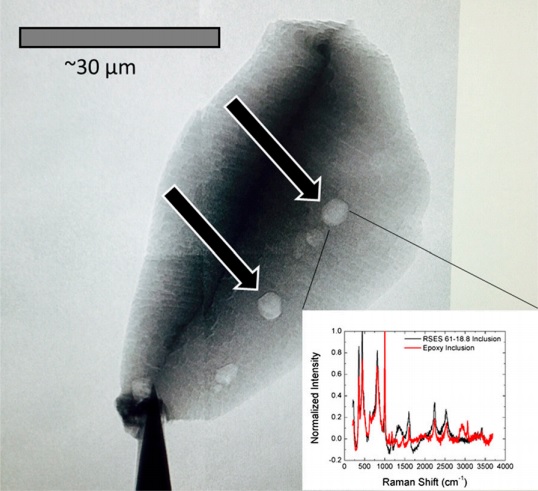
Why is this a big deal? Earth is only thought to be about 4.6 billion years old. Prior estimates of the oldest known life forms is 3.8 billion years. This discovery, if it holds up under scrutiny, effectively reduces the amount of time required for life to form by about 40%. Further, it shows that life can form under much more hostile conditions than previously thought. Around 4.1 billion years ago, Earth itself was much warmer, was getting hit by asteroids and comets a lot as well as experiencing much higher levels of volcanism than at the current time.
How does this affect our understanding of life beyond Earth? Well, life beyond Earth seems to only get more likely as our knowledge increases. The abundance of planets that can harbor liquid water, the abundance of water itself in space and the number of Earthbound extremophiles (organisms that thrive in conditions seemingly hostile to life) are all recent developments that increase the likelihood of life elsewhere. The fact that life could form so early on Earth ratchets up the likelihood of life elsewhere in the Universe just a little bit more.
Mars
Regarding the idea of life elsewhere in the Universe, Mars was once a darling. In some sense, it still is. However, the prospect for "life on Mars" has slowly been amended to "life on Mars in the past." What we see today on Mars is just not very encouraging in terms of finding life now. However, with regard to life on Mars in the past, things keep looking better.
Deep Lakes
Mars appears to have had very deep lakes in the past. By analyzing sedimentary data collected by theCuriosityrover, it looks like a lake may have been as deep as 800m (half a mile). For perspective, that's twice as deep as the deepest point in the Great Lakes. Here is one of the images studied.

Such large standing bodies of water would be very helpful for the development of life as we know it. Mind you, sedimentary data can only be collected in Curiosity's immediate vicinity. Who knows what else might be found if we could only look elsewhere?
Such large standing bodies of water would be very helpful for the development of life as we know it. Mind you, sedimentary data can only be collected in Curiosity's immediate vicinity. Who knows what else might be found if we could only look elsewhere?
Atmosphere Stripping
Another Mars result was the confirmation that the solar wind is stripping Mars' atmosphere. The usual story told about Earth is that our magnetic field keeps the solar wind from being too strong when it hits our atmosphere. As a result, Earth loses very little of its atmosphere. Mars stands in stark contrast. With no global magnetic field, the solar wind plows into Mars' atmosphere, flinging portions of it beyond the planet's gravitational reach. This story of atmospheric erosion was confirmed numerically byMAVEN'sdata, which was used to produce the following video.
If we run the process of the solar wind stripping Mars' atmosphere back billions of years, a rather significant atmosphere would have been possible. Between this and the deep lakes, an ancient Mars and current Earth would be more similar to each other than the current-day Mars.
If we run the process of the solar wind stripping Mars' atmosphere back billions of years, a rather significant atmosphere would have been possible. Between this and the deep lakes, an ancient Mars and current Earth would be more similar to each other than the current-day Mars.
Jupiter
TheHubble Space Telescopestared directly at Jupiter for a solid 10 hours. The average day on Jupiter is about 10 hours, which means almost every point on the planet was imaged twice. This is part of theOPALprogram, which will fully image every outer planet annually. Often, it is not the single still image that provides useful information, but the accumulation of data over time. It isn't clear exactly what will be learned through future imaging of the other outer planets, but the pictures sure are pretty.

Already, the rate of the Great Red Spot's shrinking has been measured and a band of wave-like structures was observed. These waves had only been observed once before. Until now, it had been presumed a fluke, which is now clearly not the case.

Already, the rate of the Great Red Spot's shrinking has been measured and a band of wave-like structures was observed. These waves had only been observed once before. Until now, it had been presumed a fluke, which is now clearly not the case.
Enceladus (Saturn)
The Cassini spacecrafttook its deepest dive through Enceladus's plume. Early on in Cassini's tour around Saturn, images showing huge geysers spewing material out of Enceladus flung it to fame. Follow-up missions determined that there is a sub-surface ocean sourcing the plumes. It was also discovered that these geysers help to source the E-ring with material. Only a few images have been released so far of this latest deep dive. Because of the size of the full data and the bandwidth available, full sets of high resolution images won't be available until 2016. However, the detail of the surface in the pictures already released is pretty amazing. Each pixel represents 50 feet across, the size of a fairly modest home.


The principal purpose of this dive, however, is not close-up imaging of Enceladus' surface, though that is a nice benefit. Scientists are most interested in the chemical composition and make-up of the plume. They are also interested in the physical nature of the plume. Though it has been imaged, the depth, density and rate of material discharge is not well-known or understood. All of this information will paint a better picture of what mechanisms are actually producing the plumes and how long they have been going on. As usual when water is involved, the conclusions will also have strong implications regarding life on the moon.
Overlapping Stars (aka VFTS 352)
Two stars were found to be so close that they are actually sharing material. Collectively, the binary is known as VFTS 352. Binary star systems that share material are known as "contact binaries" or "overcontact binaries." VFTS 352 is by no means the first contact binary system discovered. However, it is the most massive, collectively about 57 times the mass of our sun. I'm not sure why theESOdidn't release an image used by the scientists; but this artist's rendition is kinda pretty.

VFTS 352 is also unusual in how close in size the two components of the binary are. As a result, material isn't being sucked from one to the other, as is most common. Instead, the two stars are actually sharing material in what might be thought of as a stable configuration. What is potentially unique about this system is that the stars may both go supernova. If that happens, a binary black hole may form, something that hasn't been accounted for by current models of stellar evolution. Personally, I'm a little skeptical that such a thing will occur; but, I'm far less qualified to speculate about such things than the experts at ESO.

VFTS 352 is also unusual in how close in size the two components of the binary are. As a result, material isn't being sucked from one to the other, as is most common. Instead, the two stars are actually sharing material in what might be thought of as a stable configuration. What is potentially unique about this system is that the stars may both go supernova. If that happens, a binary black hole may form, something that hasn't been accounted for by current models of stellar evolution. Personally, I'm a little skeptical that such a thing will occur; but, I'm far less qualified to speculate about such things than the experts at ESO.
Comets
Comets are mainly from the Kuiper Belt and Oort Cloud. The material in these regions is considered primordial in the sense that they have changed very little since our sun began fusing. As such, they are a proxy for the conditions in the very early formation of our solar system. Discoveries related to comets, particularly their composition and chemistry, not only helps us determine which theories of solar system formation are more likely, but how quickly the complex reactions required for life might have formed. This month, two comets shed some light on these issues.
Drunk Comet (Lovejoy, of course)
Comet Lovejoy was found to have large amounts of alcohol in its tail. There are lots of forms of alcohol, but we are in fact talking about the kind that gets Samuel L Jackson drunk. Alcohol is a relatively complex molecule in the context of a pre-planetary solar system. If the extreme heating and cooling from the sun arising from comets' highly eccentric orbits brings about such complex chemistry, then life on Earth would not necessarily have had to start from complete scratch. The process that led to life on Earth could have been jump-started with complex chemicals brought by comets rather than having to synthesize everything from simple molecules like water, carbon monoxide and nitrogen.
Oxygen From Comet 67P (Churyumov-Gerasimenko)
The oxygen atom is very abundant in the Universe. However, molecular oxygen (O2) is quite rare in space because it is so reactive. O2can easily combine with hydrogen to make water, for example, and can even combine with free oxygen atoms to create ozone (O3). Nonetheless, the Rosetta spacecraftdetected O2in the tail of Comet 67P. Finding O2in a comet doesn't fit with our current models of solar system formation. The mechanisms required to trap O2within a comet are simply not there. Such a mechanism will now have to be added to account for theobservations made by Rosetta.
Saturday, July 18, 2015
Claudia Alexander

On July 11, 2015, we lost one of the world's leaders and pioneers in space science, Claudia Alexander. I had seen her on the Science Channel a few times talk about planetary evolution and thus was happy to see her familiar face as part of the Rosetta team when it rendezvoused with Comet 67/P. As anyone who follows this blog knows, I actually stay up late for news on Rosetta/Philae. Claudia had a genuineness and grace about her that is a rare gift in the sciences and she will be sorely missed.
Here are a few links for those who want to get to know her a little better.
Google Scholar's listing of her work
Her Own Page (understandably not her first priority)
Her NASA profile
Her LA Times obituary
Wednesday, July 1, 2015
All Space Considered, June 2015 (David Helfand)
The bulk of the second half of All Space Considered was spent hearing from David Helfand, Chair of the Astronomy Department at Columbia University. He didn't talk much about Columbia University, instead focusing on his past seven years at Quest University in British Columbia, Canada. I'm not much for discussion on the process of education, but Dr Helfand made many very good points and shared how Quest University has attempted to address them.
His first critique of the modern University system is its adherence to traditional lecturing. In the age of the mobile Internet, the idea that some wizened elder can bestow knowledge upon a class of curious children in a way they couldn't obtain themselves is a bit archaic.
His second critique was the isolation of disciplines. It's rare for an economics professor to talk to a music professor and even rarer for either to talk to the physics departments (I guess physics is notoriously exclusive).
His third critique was that many of the skills required to succeed in the modern world are lacking. When employers are asked what they find problematic in their interviewees, it's never a lack of coding speed or inability to use a particular piece of software. What concerns them is someone's ability to communicate and ability to think about issues from many different perspectives.
To that end, Quest University has block scheduling, no departments and a very open-ended means of earning a degree. Block scheduling means that each student only has one class at any given time. That class lasts a month and they have no other educational obligations during that month. This completely eliminates scheduling conflicts and allows for studying topics in incredible depth. When the geology class goes to Hawaii to study a particular type of volcano (which is a typical sort of experience in Quest's classes), no one can say "Oh, but I have a test I need to study for."
Instead of departments, the faculty offices are all in one giant oval and are assigned by random lot. Not only does this get people thinking about creative and original collaborations, it really serves the open-ended degree mechanism well (which I'll get to next). Of course, any University could set up physical environments to encourage cross-disciplinary mixing (though most would balk at the very mention), the lack of the very concept of "department" sets all the instructors completely free. They don't have to adhere to some special set of rules for their own department that no one else even knows about.
The open-ended degree is the most interesting part to me. After the first year, students are asked to write a problem statement. They then spend the remainder of their time addressing the problem statement. That's it. Dr Helfand went into further details about the nuts and bolts of how that's done, but from a philosophical standpoint, the student chooses what to study and is simply guided by the faculty on how that might best be accomplished.
Honestly, the whole thing sounded a little too good to be true. But then again maybe that's just jealousy. I think I would definitely have enjoyed myself quite a bit in such an environment. Everyone around me seemed to think the same.
His first critique of the modern University system is its adherence to traditional lecturing. In the age of the mobile Internet, the idea that some wizened elder can bestow knowledge upon a class of curious children in a way they couldn't obtain themselves is a bit archaic.
His second critique was the isolation of disciplines. It's rare for an economics professor to talk to a music professor and even rarer for either to talk to the physics departments (I guess physics is notoriously exclusive).
His third critique was that many of the skills required to succeed in the modern world are lacking. When employers are asked what they find problematic in their interviewees, it's never a lack of coding speed or inability to use a particular piece of software. What concerns them is someone's ability to communicate and ability to think about issues from many different perspectives.
To that end, Quest University has block scheduling, no departments and a very open-ended means of earning a degree. Block scheduling means that each student only has one class at any given time. That class lasts a month and they have no other educational obligations during that month. This completely eliminates scheduling conflicts and allows for studying topics in incredible depth. When the geology class goes to Hawaii to study a particular type of volcano (which is a typical sort of experience in Quest's classes), no one can say "Oh, but I have a test I need to study for."
Instead of departments, the faculty offices are all in one giant oval and are assigned by random lot. Not only does this get people thinking about creative and original collaborations, it really serves the open-ended degree mechanism well (which I'll get to next). Of course, any University could set up physical environments to encourage cross-disciplinary mixing (though most would balk at the very mention), the lack of the very concept of "department" sets all the instructors completely free. They don't have to adhere to some special set of rules for their own department that no one else even knows about.
The open-ended degree is the most interesting part to me. After the first year, students are asked to write a problem statement. They then spend the remainder of their time addressing the problem statement. That's it. Dr Helfand went into further details about the nuts and bolts of how that's done, but from a philosophical standpoint, the student chooses what to study and is simply guided by the faculty on how that might best be accomplished.
Honestly, the whole thing sounded a little too good to be true. But then again maybe that's just jealousy. I think I would definitely have enjoyed myself quite a bit in such an environment. Everyone around me seemed to think the same.
Tuesday, June 30, 2015
All Space Considered, June 2015 (Beyond the Solar System)
As usual, the fine folks at Griffith Observatory held All Space Considered on the first Friday of June 2015. Here's what they had to say about the goings-on beyond our solar system.
Galactic jets are not very well understood due to their highly relativistic nature. In layman's terms, things moving that freakin fast are hard to see clearly. What was observed for the first time in the series of pictures from Hubble taken over the span of 20 years (animated in the video below) was a collision of black hole jet material with other black hole jet material.
This in itself is a wonderful observation, but more important is that it gives us a target of observation for further study of this phenomenon. We can now watch the evolution of these jets and see how the energy is dissipated, hopefully across the entire spectrum.

Galactic Jets
For the first time, a collision of material within a black hole jet was observed. Black holes have event horizons, a proverbial point of no return. Once something crosses that event horizon, it will never escape. However, a particle with enough energy can get arbitrarily close to the event horizon and still get out. Due to the dynamics of black holes (most notably spin) those high energy particles form jets focused along the black hole's axis.Galactic jets are not very well understood due to their highly relativistic nature. In layman's terms, things moving that freakin fast are hard to see clearly. What was observed for the first time in the series of pictures from Hubble taken over the span of 20 years (animated in the video below) was a collision of black hole jet material with other black hole jet material.
This in itself is a wonderful observation, but more important is that it gives us a target of observation for further study of this phenomenon. We can now watch the evolution of these jets and see how the energy is dissipated, hopefully across the entire spectrum.
Gassy Andromeda
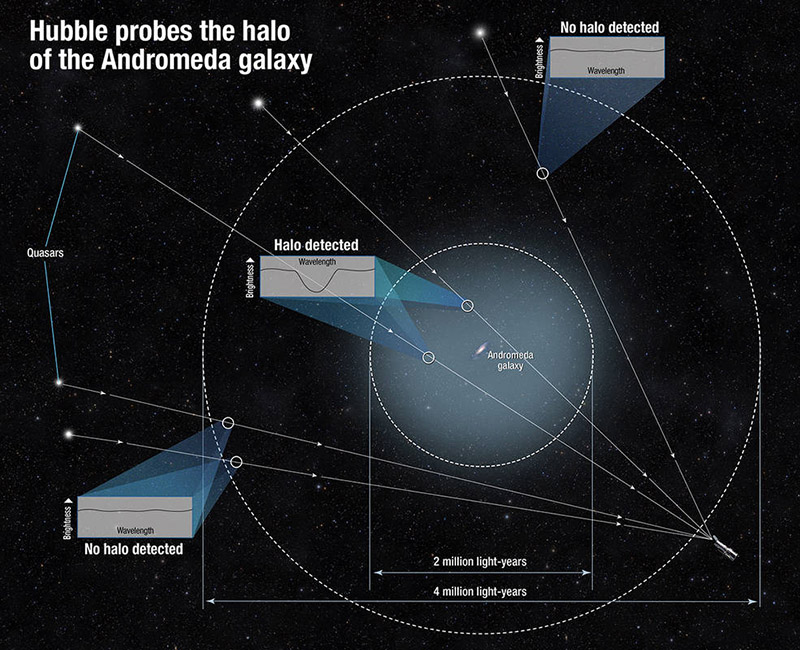
The halo of gas surrounding Andromeda, our nearest galactic neighbor, was probed much in the same way the Milky Way's jets were probed as reported in the February, 2015 edition of All Space Considered. Background quasars were used to see how far out the gassy halo extended (see image below for further explanation) and it turned out to be much larger than anticipated. In previous studies of this sort looking at halos around other galaxies, only one quasar could be used due to the distance of the galaxy and rather small portion of the sky covered as seen from Earth. Because Andromeda is so close, it appears about 6 times the diameter of the moon from Earth. This halo would cover a gargantuan 100 times the diameter of the moon in the sky. That's about half the distance from the Milky Way to Andromeda. If the Milky Way has a similar halo, it could be that the galaxies are already merging on the fringes, long before the main parts of the galaxies merge, roughly 4 billion years from now.
Dark Globular Clusters
Globular clusters with much higher mass than predicted have been found in nearby elliptical galaxy Centaurus A. This observation was made comparing the motions of over a hundred of Centaurus A's globular clusters and looking at the motions of the stars and the clusters themselves around the galaxy. When comparing the masses of the clusters from that data to the mass predicted by surveying the observable stars in the cluster, it became apparent that much of the mass is invisible. For now, it's not clear where the mass comes from. The leading candidate is dark matter. For reasons beyond my understanding, it is generally thought that globular clusters such as M13, depicted below, do not contain very much dark matter. If the clusters do indeed end up harboring dark matter, it would be a new classification of astronomical object.


Supernovae
It's starting to look like there are at least two different ways for Type 1a supernova to occur. In most popular science media I've seen, the "single-degenerate" model is shown. This is where a white dwarf sucks material off of a companion star until it hits critical mass, at which point the Type 1a supernova happens. There is also the "double-degenerate" model in which two white dwarfs merge, collectively going over the critical mass. Between two different papers published in May, evidence for both types was seen. In one paper, a supernova exhibited a spike in ultraviolet radiation, thought to be generated by the supernova slamming into the companion star. In the picture below, the brown region represents the supernova. It is shown as it engulfs the companion star, shown in white and blue.

In the other paper studying type 1a supernovae, three were examined that did not exhibit this spike. This would seem to indicate these supernovae were a result of the double-degenerate model. If the term "degenerate" confuses you, it merely refers to the number of white dwarfs involved in the supernova. White dwarfs are "degenerate" in the sense that they have stopped fusing material.
The reason cosmologists care so much about Type 1a supernova is they are a key component to the body of evidence for dark energy, that which is responsible for the accelerating expansion of the universe. The more we understand Type 1a supernovae, the more we can say about what we've seen about them at all cosmic distances, from within the Milky Way to the edge of the observable universe.

In the other paper studying type 1a supernovae, three were examined that did not exhibit this spike. This would seem to indicate these supernovae were a result of the double-degenerate model. If the term "degenerate" confuses you, it merely refers to the number of white dwarfs involved in the supernova. White dwarfs are "degenerate" in the sense that they have stopped fusing material.
The reason cosmologists care so much about Type 1a supernova is they are a key component to the body of evidence for dark energy, that which is responsible for the accelerating expansion of the universe. The more we understand Type 1a supernovae, the more we can say about what we've seen about them at all cosmic distances, from within the Milky Way to the edge of the observable universe.
Monday, June 29, 2015
All Space Considered, June 2015 (Solar System)
As usual, the fine folks at Griffith Observatory held All Space Considered on the first Friday of June 2015. Here's what they had to say about the goings-on in our solar system. Unfortunately, due to the timing of Independence Day, there will be no July 2015 All Space Considered, but that will give you more time to prepare for Plutopalooza.

The closest approach will be quite early in the morning on July 14. However, there is no need to stay up late or get up early for the occasion for several reasons. First, it takes a few hours for radio signals sent from Pluto to reach Earth. Second, the transmissions data rate is very low (about 1kbps). Third, New Horizons has no moving parts. This means only very infrequently can it point a camera at Pluto and simultaneously point an antenna at Earth. Most of the data will be gathered and stored during the closest approach and be sent back to Earth later.
Hubble has not been ignoring Pluto just because New Horizons is on its way. It has been peering at Pluto's moons and has found that they tumble rather chaotically. Due to the high relative mass of Charon (Pluto's largest moon) to Pluto, the smaller moons are effectively navigating a binary gravitational system. This causes them to wobble in their orbits and tumble around in their rotations. This would be very disorienting because it means if you were sitting stationary on the moon's surface, you would see the sun rise from a different direction each day. Below is a video of what Nix would look like from the center of mass of the Pluto-Charon system.
NASA also has a pretty cool web app to show where New Horizons is at the moment, as well as a few others showing which of the receiving stations on Earth is collecting data from it. Due to the different directions all of our various satellites are in the solar system from Earth, several ground-based stations receive data from any given satellite.
Dwarfs
We currently have two probes studying dwarf planets. Not that long ago, "dwarf planet" wasn't even a real term. The discovery of Eris, thought by its discoverers to be the 10th planet, forced astronomers to reconsider what exactly a planet is. In doing so, it came up with three criteria.- It must orbit the sun
- It must be more or less spherical in shape due to its own gravity
- It must have cleared its orbital neighborhood
This, of course, led to the downfall of Pluto from planet status because it failed to meet criteria 3. Along with the above definition of "planet," it was decided any other body that meets criteria 1 and 2 but fails 3 would be called a "dwarf planet." This seemed an unfair fate for Pluto, beloved for decades as a planet. However, it did lift Ceres out of non-planet status. These two dwarf planets are the ones we have probes studying right now.
Pluto
The New Horizons spacecraft is the first dedicated to the study of Pluto. Back in January, Alan Stern, the Principal Scientific Investigator, visited with All Space Considered. He stated then that we would soon get our best pictures of Pluto ever and New Horizons has not disappointed. While the released images still look all blurry and pixelated, their resolution exceeds any image we've ever taken of Pluto, including by the Hubble space telescope. Also, they are getting sharper every day. Even since All Space Considered, new images have been released at even higher resolution.
The closest approach will be quite early in the morning on July 14. However, there is no need to stay up late or get up early for the occasion for several reasons. First, it takes a few hours for radio signals sent from Pluto to reach Earth. Second, the transmissions data rate is very low (about 1kbps). Third, New Horizons has no moving parts. This means only very infrequently can it point a camera at Pluto and simultaneously point an antenna at Earth. Most of the data will be gathered and stored during the closest approach and be sent back to Earth later.
Hubble has not been ignoring Pluto just because New Horizons is on its way. It has been peering at Pluto's moons and has found that they tumble rather chaotically. Due to the high relative mass of Charon (Pluto's largest moon) to Pluto, the smaller moons are effectively navigating a binary gravitational system. This causes them to wobble in their orbits and tumble around in their rotations. This would be very disorienting because it means if you were sitting stationary on the moon's surface, you would see the sun rise from a different direction each day. Below is a video of what Nix would look like from the center of mass of the Pluto-Charon system.
NASA also has a pretty cool web app to show where New Horizons is at the moment, as well as a few others showing which of the receiving stations on Earth is collecting data from it. Due to the different directions all of our various satellites are in the solar system from Earth, several ground-based stations receive data from any given satellite.
Ceres
While the Dawn spacecraft continues to take many images of Ceres of breathtaking detail, the most notable features have definitely been the bright spots in one of the craters. It almost looks like a light seen through a napkin with holes in it. Such brightness amidst so many craters has not been observed thus far on any other body in the solar system. Below is one of the pictures of the bright spots.

Since All Space Considered, it has been concluded that the spots are composed of highly reflective material. What the specific material is or what process deposited them there (volcanism, erosion, etc) is still unknown.


Since All Space Considered, it has been concluded that the spots are composed of highly reflective material. What the specific material is or what process deposited them there (volcanism, erosion, etc) is still unknown.
Comet 67/P (Churyumov/Gerasimenko)
The biggest news since All Space Considered involving Comet 67/P is, of course, the awakening of Philae, the spacecraft that landed on Comet 67/P as part of ESA's Rosetta mission. Unfortunately, there has been little news from Philae. Due to its exact position on the comet being unknown and the relatively surprising nature of the initial contact, the orbiter, Rosetta, was not in an ideal position to communicate with Philae. Mission control is, of course, doing everything within reason to gather as much information from Philae as possible. The comet has become very active of late, making getting closer a somewhat dangerous affair.
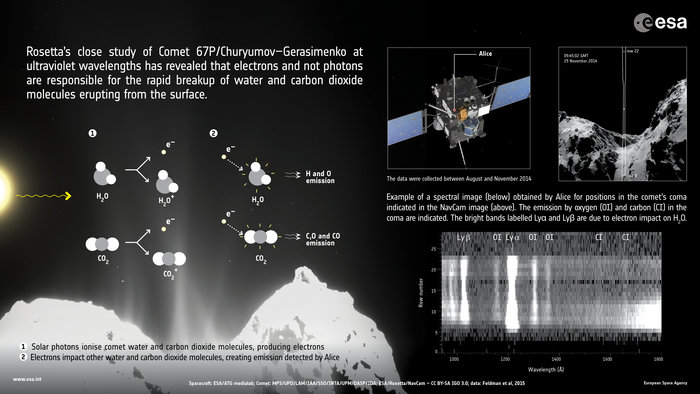
Prior to this announcement, however, there was some interesting science returned from Rosetta. It was discovered that the water and carbon dioxide plumes break down in a two-step process. From Earth, all we can deduce is that these molecules have been broken up and it had always been assumed that this was a result of ultraviolet light. Even the most powerful Earth-based and Earth-orbiting observatories can only observe the phenomenon to a resolution of miles. Rosetta is able to observe at much higher resolution and discovered that the direct breakdown of these molecules form ultraviolet light is just the first stage. Once a molecule has been broken up by ultraviolet light, energetic electrons are emitted that break up yet another molecule. They were able to deduce this by looking at the relative energies of the broken-up molecules in the ultraviolet spectrum. The following diagram illustrates this two-stage process.
Io Volcanism
We often refer to Titan, the largest moon of Saturn, as the only celestial body besides Earth to harbor standing liquid on its surface. It's possible it still is, but Io is trying to share in Titan's glory. Recent images from LBTO (a pretty badass binocular telescope) show a hot spot in a depression known as a patera. It's been well-known for some time that Io is the most volcanic body in the solar system. Naturally, some of that volcanism leads to liquid lava on its surface. What this new observation points to, however, is a lake of lava. Parts of it solidify, but other parts stay liquid and vent the heat. Below is the LBTO image (orange) overlaid on a black and white Voyager surface image at the same location.
Monday, June 15, 2015
Philae Awake!
As I prepare my posts from the most recent All Space Considered, the ESA has released news that Philae is awake! I simply can not contain my joy, despite not knowing what data Philae has sent back. As yet, there are no details, but I nonetheless rejoice.
Monday, March 2, 2015
All Space Considered, Feb 2015 (The Rest)
Comet 67P (Churyumov-Gerasimenko)
While Philae is asleep on the surface of Comet 67P, Rosetta continues to study it from a distance. A special edition of the journal Science dedicated to Rosetta's findings was published. There are far too many for me to go into detail here on all of them. The ESA's blog post on the findings gives a summary as well as resources for follow-up reading. The one item I will mention that was discussed at All Space Considered is that the surface of Comet 67P seems to have a much higher level of diversity than previously thought. Two principal ideas were put forward to account for Comet 67P's dual-lobe shape. It was hypothesized that either two bodies collided and merged or Comet 67P started as a single object and internal processes driven by close approaches to the sun blew off a middle band. Rather than just seeing one or two different surface types, as would support either of those theories, it turns out Comet 67P has 19 different regions (outlined in graphic below) that accommodate at least 5 rather diverse types of terrain. Some new theories will have to be put forth to explain Rosetta's findings.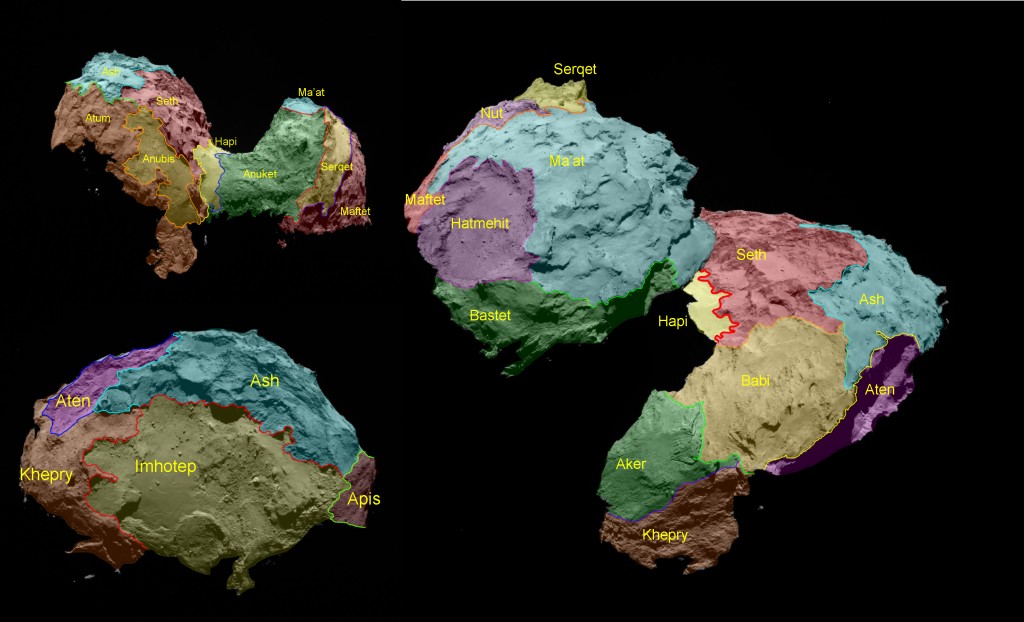
On a more human note, Comet 67P is often referred to as "Churyumov-Gerasimenko" after its two discoverers. It turns out both of them, Klim Churyumov and Svetlana Gerasimenko, had birthdays in February.
Milky Way's Puffing Black Hole
Another discovery about our Milky Way was that the black hole at the center of it is emitting plumes of material. Hubble made many observations using background quasars as a reference. By seeing how the light from these quasars change on the way through the huge outflows, chemical composition, speed and other characteristics could be deduced. It's not known exactly what caused these huge plumes to be ejected and only further observations will settle the issue. However, this is, of course, by far the closest instance of such galactic plumes, so we will be able to gather much better data on this than ones we see from other galactic centers. One idea of what might have caused this is a frenzy of star formation near the galactic center. Another idea is that a large number of stars got gobbled up by our galactic black hole around the same time, ejecting a lot more gas and other material than normal. Below is an image describing how the velocity of the material in the plumes was measured.
The EAGLE Simulation
Universe simulation was again fairly successful. The EAGLE simulation started with nothing more than some energy, a huge simulated volume and the known laws of physics. It actually ended up creating galaxies, complete with spirals and ellipticals, as well as clusters and superclusters as seen in the current Universe. It's not clear to me how this differs from Illustris from back in May. There was no discussion of the differences and similarities between the two, but at least on the surface, they seem to be doing the same thing. That's a great thing in science because it provides corroboration. If one had succeeded and the other failed, the most likely cause would have been human error. In any case, here's a cool visualization of an "instant" in time during the simulation.
All Space Considered, Feb 2015 (Exoplanets)
Exoplanets
Giant Ring System
So January 2015 was a good month for exoplanet news. All kinds of cool findings were made. The lead off here has a very cool video to go with it.There are lots of other pretty artist depictions of this giant ring system, but I like this video because it shows the actual transit data along the bottom. The transit method is one of the primary ways we've detected exoplanets in the past 10-20 years and usually the data tell us about the planet itself. In this case, the transit data packed quite a surprise, one whose best explanation at the moment is a huge ring system. How huge? When we think "ring system," almost universally people will think of Saturn, with good reason. It has by far the largest and most prominent ring system in our sun's domain. If the data we collected really do show a ring system as hypothesized, here's what the behemoth would look like in our sky if placed where Saturn is.
 |
| Yup, that's our moon on the left, getting dwarfed |
Could this possibly be such a ring system that seemingly only science fiction would dream up? For me, the most convincing part is the symmetry, that the star had to pass both into and out of the ring system. I suppose the tilt of the rings and the orbit of the planet with respect to Earth's line of sight to the star might provide enough degrees of freedom to fit any data; but enough experts are convinced that I'm going to believe it for now.
Doubled the Discovered Goldilocks Planets
While the ring system makes for pretty pictures, what exoplanet hunters are really after is Earth-like planets, ones in the "Goldilocks" zone where liquid water on the surface is likely and roughly the same size as Earth. Well, we found 8 more, bringing the overall total to 16. Such planets are of extreme interest for at least two reasons. The first is that human-like life is most likely to exist on such a planet. There is always the possibility that non-human-like life exists on other planets, but we're of course most interested in the life that we are most compatible with. The second reason is exploring the possibility of human life somewhere besides Earth. Mars occasionally comes up as a candidate, but its thin atmosphere makes it a pretty poor candidate. It is still nonetheless the best candidate in the solar system. That means to find a truly great candidate, we must look beyond our solar system.Super-Earths Superer than Earth at Holding Oceans
Another point of discussion was theoretical work done regarding the development of oceans and a planet's ability to retain one oceans once they had been established. It is, of course, nice if a planet has liquid water. However, if it is like Mars, that water disappears quickly and the window of opportunity for life as we know it to form is over. Harvards Center for Astrophysics has determined that planets 2-4 times the mass of Earth seem to be the best at both forming oceans and retaining them once formed. The main impact of this research is that if we want to look for liquid water, we should target searches for planets in this mass range most heavily.
It bears remarking that the rate of exoplanet discovery in the past 10 years has been just plain crazy. Not long ago, we weren't even sure if we could detect exoplanets. Now, we've found more than all but the most popular people have friends on Facebook. It's almost certain that we'll find more than the single most popular person has friends on Facebook soon. "Friends on Facebook" may seem a frivolous measure, but I bring it up because it means that for each person you have had any personal interaction with, there is an exoplanet that has been discovered and confirmed. Given that all of this has happened within a relatively small region of our own galaxy, which itself is only one of hundreds of billions in the observable Universe, and the sheer scale of the diversity and possibilities become incomprehensible rather quickly.
NGTS
In the vein of accelerated discovery, a new planet-hunting telescope saw first light in January. I'm not sure if this was indeed mentioned at All Space Considered, but I think it's important enough to mention. To date, the space-based Kepler telescope has been doing the lion's share of the exoplanet discovery. It has been hobbled of late by failing mechanics, but had long surpassed its original mission length and still continues to amazing work even in its current state. NGTS is a ground-based telescope that will look at much brighter stars than Kepler and sweep out a larger region of the sky than Kepler. Like Kepler, much of NGTS's work will be to provide candidates for follow-on observations with more specialized telescopes. Standard transit observations can deduce size, mass and orbit of an exoplanet. Follow-on measurements use spectroscopy while the planet is in-transit to determine the chemical composition and depth of the planet's atmosphere.
Subscribe to:
Posts (Atom)