Venus Express
On February 6, I once again attended All Space Considered at Griffith Observatory. The highlight of this particular All Space Considered was a video call-in session with David Grinspoon, a man who holds many titles, but was speaking to us primarily as Interdisciplinary Scientist for the ESA's Venus Express mission. Grinspoon was very engaging in charismatic while telling us about the principal results of the mission.Active Volcanism
One of Venus Express's goals was to determine if there is active volcanism on Venus. It has long been hypothesized that there is based on radar images of the surface taken by NASA's Magellan mission. While Venus Express did not find a smoking gun and no direct image of an erupting volcano was captured, the evidence gathered in favor of active volcanism fell just short of that. Two pieces of data point towards current active volcanism. The first was spectral emissivity data. This indicated that the lava flows found by Magellan were relatively pristine and therefore young. Below is an image of this emissivity data overlaid onto Magellan radar data.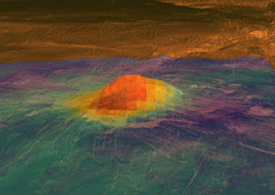
The red area essentially shows elevated heat levels, something that should dissipate over time. By looking at the heat, the age of the lava flow can approximated. The second piece of evidence of active volcanism on Venus was sulphur dioxide content in the atmosphere. Rather high levels were detected that dissipated quite quickly, strongly indicating that there was an eruption somewhere that Venus Express wasn't looking.
Lightning
Another goal of Venus Express was detecting lightning. "Smoking gun" evidence for this is even more challenging than volcanism, as anyone who has tried to photograph lightning on Earth probably knows. However, large electromagnetic spikes were measured and there really is no explanation other than lightning occurring in the upper reaches of Venus's atmosphere.Polar Vortices
The conversation with Grinspoon went on to quite a few more topics, but the last that I will discuss here are the polar vortices of Venus. Saturn's hexagon is fairly well-known at this point; and we can even recreate it in the lab. It turns out Venus may have a similar phenomenon going on. However, Venus's southern vortex is far more dynamic. For starters, its center of rotation is not aligned with the planet's south pole. It tends to "orbit" the south pole every 5-10 Earth days. The existence of the vortex already tells us that there is highly dynamic weather on Venus. An orbiting vortex kicks up the dynamic factor quite a bit. Things around the vortex are continuously "kicking" it around. On top of all that, the shape of the vortex changes at quite a rapid pace. Below is an animated GIF of the phenomenon.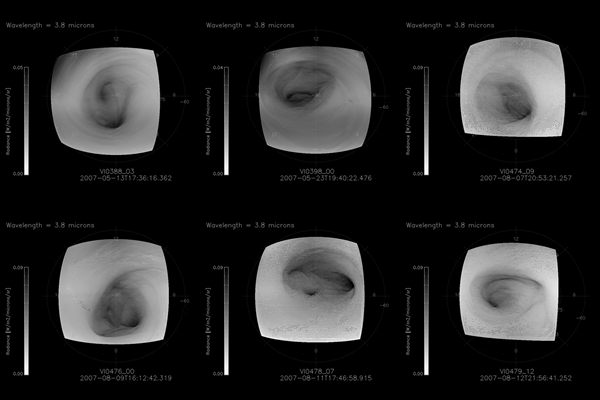
Venus Express had much more to teach us about Venus. For anyone who's interested, the ESA's Venus Express site is an excellent informational resource.

No comments:
Post a Comment