Planetary News
The big treat of this particular installment of All Space Considered was guest Emily Lakdawalla, Senior Editor and Planetary Evangelist of The Planetary Society. There was a fair amount of solar system news, so she had much to say.Rosetta
First and foremost, Philae is a probe that has been carried by Rosetta out to Comet 67P/Churyumov-Gerasimenko. Rosetta actually arrived at the comet back in August and has since been trying to find a decent landing site for Philae, which will be sent to the surface of the comet. After much deliberation, Philae is almost ready to depart Rosetta. It is happening THIS WEDNESDAY MORNING, 7AM PT. It will be streamed everywhere. Have a look at it! This will be an historic event and there's very little you could possibly be doing that you'd want to miss this for.Siding Spring
One major, major piece of luck (once in 8 million years level of luck) that people studying Mars received was comet Siding Spring passing close enough to Mars to have significant portions of its coma (aka tail) enter the Martian atmosphere. This coincided perfectly with the arrival of MAVEN, which joined six other active spacecraft at Mars. While none of the craft were specifically designed to study comets, MAVEN was designed to study the Martian atmosphere. With so much alien debris raining through the atmosphere, MAVEN was able to provide useful information about the composition of the comet and how that composition interacts with Mars. One big surprise was how quickly some of the materials dissipated. This did not match models, which means we learned something.Misc
Mercury has ice water on it. Yes, Mercury, where temperatures at the surface normally boil water, has ice. Messenger recently sent back pictures confirming that polar craters have regions where there is never sunshine. Like being in the desert at night, these places have nothing regulating the temperature and so are extremely cold.
New Horizons nearing Pluto. New Horizons is nearing Pluto and will start snapping pictures in early 2015. The news for this month was that a second Kuiper Belt object was found for New Horizons to target after it passes Pluto. After several failed searches for such an object with lesser telescopes, Hubble came to the rescue to find a target.
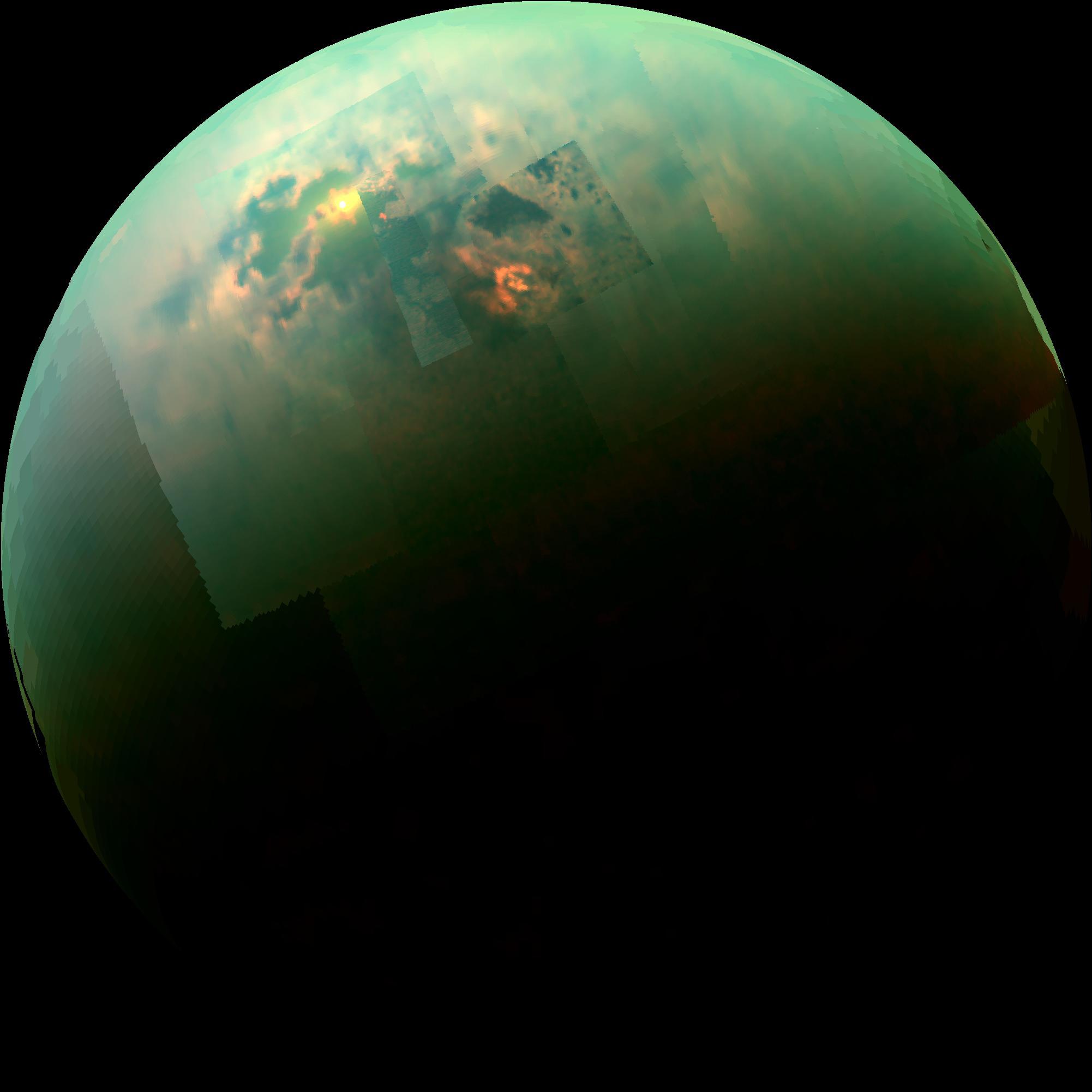
And here's a really pretty picture. There are lakes of hydrocarbons on Titan. Like lakes on earth, if you're in the right place at the right time, you can see the sun reflect off these lakes. Here it is:
Non-planetary News
Private Space Setbacks
The biggest astronomical news was the recent failed launches of an Antares rocket as well as Virgin Galactic's SpaceShipTwo. These were, of course, unfortunate events, especially the loss of life; but there's been plenty of coverage of this elsewhere and I won't dwell on it here.
Lunar Eclipse
There was a total lunar eclipse in October. Lots of pretty pictures were taken and shared by the staff astronomers. And, of course, there was a reminder of the total solar eclipse that will take place on 21 August 2017. It will be visible within just a few hour's drive from almost all of the continental United States, so there is no excuse not to see it. It is an amazing and transformative experience. That said, I don't get too excited about eclipses only because there isn't a lot of science to be gained from them anymore. We've learned much of what there is to learn. However, that doesn't mean I won't stand in awe in August 2017!
As always, I'm sure I've left something marvelous and interesting out. My memory isn't perfect and isn't getting any better over time. If anyone has anything they'd like to add, please let me know in the comments!

No comments:
Post a Comment